


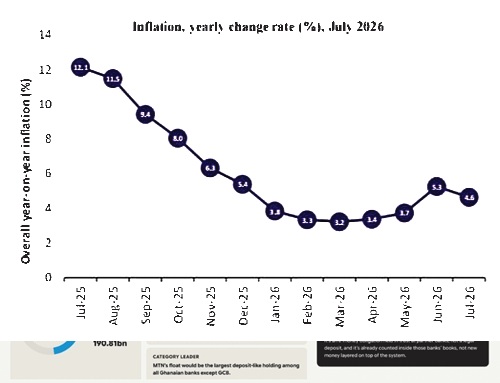
Ghana's inflation rate fell to 4.6 per cent in July 2026 from 5.3 per cent in June as slower food price increases helped reduce the overall cost of living, offering businesses and consumers further relief amid the country's economic recovery.
The latest Consumer Price Index (CPI) released by the Ghana Statistical Service showed that the year-on-year inflation rate declined for the first time since March. The CPI measures changes in the prices of goods and services purchased by households, using 2021 as the base year.
The data showed that monthly inflation stood at 0.1 per cent in July, indicating that prices remained largely stable compared with June. Food and non-alcoholic beverages recorded an annual inflation rate of 3.1 per cent, while non-food inflation stood at 6.1 per cent.
Regional inflation rates varied widely across the country. The Bono East Region recorded the lowest inflation rate at minus 3.8 per cent, while the North East Region registered the highest at 10.8 per cent. Six regions recorded inflation rates above the national average of 4.6 per cent.
Government Statistician Alhassan Iddrisu attributed the decline mainly to easing food inflation, noting that domestic factors continued to play the biggest role in determining price movements.
"Food prices continue to stabilise, and that is helping to slow overall inflation. We also see that domestic costs remain the main driver of inflation, which means maintaining stability in transport, energy and local production is important," he said.
The statistics service estimated that more than 86 per cent of Ghana's inflation was generated by goods and services produced within the country, highlighting the influence of domestic costs on overall price trends.
Outlook
The latest inflation reading represented a sharp improvement from the 12.1 per cent recorded in July 2025. Over the past year, the pace of price increases had more than halved, reflecting improving macroeconomic conditions.
The decline came as the government maintained its macroeconomic targets in the 2026 Mid-Year Budget Review, citing stronger economic growth, fiscal consolidation and improved stability. The easing inflation rate is also expected to support business planning by reducing uncertainty over operating costs.
The Bank of Ghana also kept its policy rate unchanged at its July meeting for the second consecutive time, maintaining that caution remained necessary to keep inflation within its medium-term target band of 6 to 10 per cent.
Business impact
Lower inflation is expected to ease cost pressures for businesses, particularly those dependent on food inputs and locally sourced goods, while supporting household purchasing power if the trend is sustained.
An economist said the latest figures suggested that price pressures were becoming more manageable but warned that businesses should remain cautious.
"The inflation numbers point to improving stability and that supports investment and business confidence. However, firms still need to monitor domestic costs closely because transport, utilities and other local factors continue to influence prices," she said.