


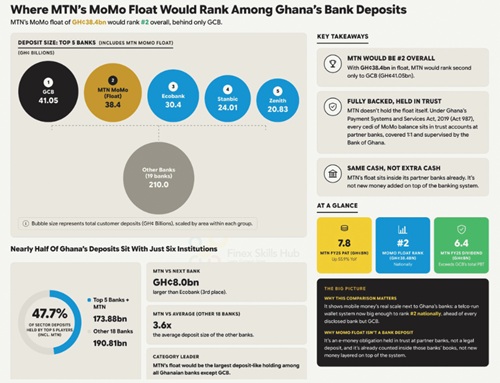
MTN Ghana's mobile money arm is holding customer funds on a scale that puts it second only to the country's largest bank, according to a comparison of the company’s audited financial statements, underscoring how quickly mobile payments have grown into a pillar of the country’s financial system.
The float in MTN's Mobile Money, or MoMo, wallets stood at GH¢38.4bn ($2.4 billion) in the 2025 financial year. That would rank second among Ghana's deposit-taking institutions if placed on the same footing as banks, behind only GCB Bank's GH¢41.05bn in customer deposits and ahead of every other lender, including Ecobank Ghana, by around GH¢8bn. MTN's float is not legally classified as a bank deposit. Under a 2019 law governing digital payments, funds held in mobile money wallets must be placed in trust accounts at licensed banks and are supervised by the central bank, the Bank of Ghana.
Analysts say that legal distinction means the comparison with bank deposits is illustrative rather than a direct accounting equivalence."The Bank of Ghana and the government, for that matter, must encourage the use of digital payment," a Data analyst and founder of international research firm Finex Skill hub, Bernard Obeng Boateng, said,pointing to savings on the cost of printing banknotes and minting coins as adoption grows.
Concentration in focus
The size of MTN's float has drawn attention to how concentrated customer funds have become among a small number of institutions.Ghana's five largest banks, together with MTN's float, hold a combined Gh¢173.88bn, or 47.7 per cent of the customer funds represented in the comparison. The remaining 18 licensed banks in the country hold Gh¢190.81bn between them.MTN's float is roughly 3.6 times the average deposit base of those 18 smaller banks, the data show. Such concentration would typically prompt scrutiny of systemic risk, though several analysts noted that MTN's mobile money operation falls outside the regulatory framework applied to deposit-taking banks, since the underlying funds are held in bank trust accounts rather than on MTN's own balance sheet.
Strong earnings
The float's growth has coincided with a strong financial performance at MTN Ghana more broadly.
The company reported after-tax profit of Gh¢7.8bn for the 2025 financial year, up 55.9 per cent from a year earlier, and paid dividends of Gh¢ 6.4bn, exceeding GCB Bank's total profit after tax over the same period.
Mr Boateng said transaction data generated by mobile money use could eventually be structured to help small businesses secure financing, an application he described as underused.
Context
Mobile money has expanded rapidly across the country in recent years, with wallets increasingly used for salary payments, bill payments, merchant transactions and savings,alongside person-to-person transfers.
The trend mirrors developments elsewhere in sub-Saharan Africa, where mobile money platforms operated by telecoms companies have in some markets outpaced formal
banking penetration.
MTN Ghana has not been designated a deposit- taking institution and industry analysts say there is no indication regulators are considering reclassifying its mobile money business.
The comparison with bank deposits, they say, is intended to illustrate the scale mobile money
has reached in Ghana's economy rather than to suggest a change in MTN's legal or regulatory status.
Even so, some analysts say the gap between MTN's economic footprint and its regulatory classification is likely to remain a live topic among policymakers as mobile money
continues to grow.
They point to the broader question facing regulators across the region: how to supervise financial risk that is increasingly generated by technology platforms rather than by licensed banks, even when those platforms operate, as MTN does, within the letter of existing law.
For now, MTN Ghana's mobile money business continues to operate under its existing licensing arrangement, with funds remaining in bank trust accounts overseen by the Bank of Ghana. Company officials have not indicated any plans to seek a banking license or to alter the platform's
regulatory status.