
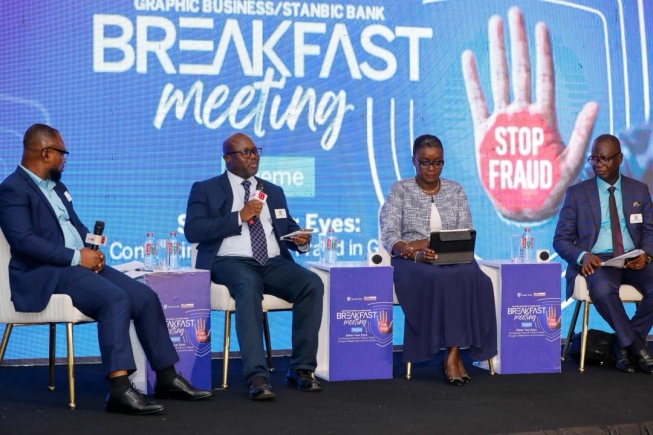
Yesterday, the Graphic Business/Stanbic Bank Breakfast Meeting put one blunt warning on the table: financial fraud is now one of the most pressing threats to Ghana’s digital economy.
Mobile money scams, identity theft, SIM swap fraud, fake investment platforms, and online marketplace cons are no longer isolated crimes.
They are a coordinated attack on the trust that holds our digital financial system together.
The meeting’s theme, “Shine Your Eyes: Combating Financial Fraud in Ghana through Collaboration and Innovation”, could not be more timely.
As digital banking, mobile money, and fintech expand financial inclusion for millions, they also expand the playground for criminals.
The Chief Executive Officer of Stanbic Bank Ghana, Kwamina Asomaning, captured it best: “At its core, fraud is not merely a financial crime. It is an attack on trust.”
He is right.
A banking system without trust is just software and buildings.
When a trader in Kumasi hesitates to accept mobile money because she fears a reversal scam, when a pensioner in Accra refuses to click a link from his bank, when an SME owner avoids online payments because of fake investment traps - the economy loses.
Participation declines.
Growth slows.
The consequences go beyond money lost.
Fraud undermines confidence in digital services and threatens the foundation of a thriving digital economy.
Ghana has spent years and billions pushing digitalisation.
Ghana Card, interoperability, digital address, paperless ports - all depend on citizens believing their data and money are safe.
One successful SIM swap or fake loan app can undo years of that work for an entire community.
The numbers are not just statistics.
They are school fees lost to a fake investment scheme, market capital wiped out by a phishing link, a family’s savings drained because someone shared an OTP.
That is why the Graphic Communications Group Ltd and Stanbic Bank brought together the Police CID Financial Forensics Unit, the Cyber Security Authority (CSA), banks, telecoms and policymakers. Fraud cuts across sectors, so the response must too.
Collaboration is not a buzzword; it is the strategy.
The government alone cannot win this battle.
No single institution can combat financial fraud in isolation.
Success requires collective action.
What should that look like in practice? Faster information sharing. Fraudsters move in minutes.
Banks, telcos, CSA, CID, and fintech must share threat intelligence in real time, not in quarterly reports.
When a new SIM swap pattern emerges in Tamale, Accra and Takoradi must know before lunch.
The CID Financial Forensics Unit and CSA’s Law Enforcement Liaison Unit must be at the centre of that operation.
Regulations must keep pace with tactics.
SIM swap fraud thrives on weak identity verification.
Digital identity systems must be secure but user-friendly.
Fake investment platforms thrive on poor enforcement.
Regulators must work with platforms, domain registrars, and social media companies to take down fraudulent sites faster.
Rules without enforcement are just paper.
Investigators, prosecutors, and judges need tools and training to handle cybercrime.
Financial forensics must be as well-resourced as physical forensics.
Banks and telcos must invest in AI-driven fraud detection, but also in staff who can explain to customers why a transaction was blocked.
Security cannot be so complex that it excludes the very people digital inclusion is meant to serve.
Technology will never eliminate fraud if users remain vulnerable.
Digital literacy must go hand in hand with digital inclusion.
As more Ghanaians come online, especially the elderly and those in rural areas, we must teach them the rules of the road: No legitimate bank will ask for your PIN or OTP.
If an offer looks too good to be true, it is.
When in doubt, call your bank or telco directly.
Naming and shaming fraudsters, exposing their tactics, and celebrating citizens and institutions that stop fraud - that changes norms.
The uncomfortable truth is that fraudsters innovate faster than institutions.
As soon as banks block one scam, criminals invent three more.
That means our response must evolve faster.
“Shine Your Eyes” is not just advice to citizens; it is a charge to regulators, banks, telcos, tech firms, law enforcement, and the media to stay alert, share data, and act decisively.
Ghana’s digital economy has enormous potential.
Mobile money agents in every corner.
Fintechs solving real problems.
Businesses reaching new markets online.
But that potential collapses if trust collapses.
Fraud is an attack on trust.
Our defence must be trust built on collaboration, innovation, and personal responsibility.
The breakfast meeting is over.
The real work starts now.
And all of us - government, business and citizens - must “shine our eyes”.
