
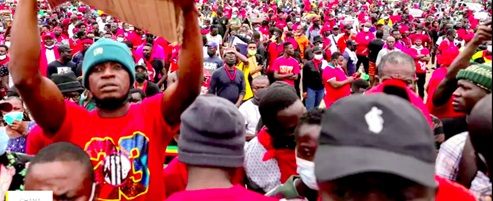
South Africa has a serious problem.
Organised mobs are attacking black African residents -- documented and undocumented alike.
Businesses are being looted. People are being beaten. A Nigerian national died in Pretoria police custody.
A Malawian child was turned away from a hospital. In Estcourt, a mayor physically confiscated the keys of Ghanaian shopkeepers and handed their businesses to locals.
The movement is called March and March, founded by former radio presenter Jacinta Ngobese-Zuma.
It claims to target only undocumented migrants. Human Rights Watch documented what actually happened: indiscriminate violence against legal African residents, with police standing largely aside.
Call it what it is. This is not xenophobia.
White and Asian foreigners are not being attacked.
This is Afrophobia -- Africa turning on itself.
The ANC government, now enabling this through silence, owes its very existence to the solidarity of Ghana, Nigeria, Zimbabwe and Tanzania during apartheid.
South Africans' distrust of African migrants has climbed from 62.6% to 73.1% since 2021. Local government elections are due by January 2027.
The government has done the political calculation.
It is the wrong one.
Fallout
The continent responded with speed and unity. Ghana's Foreign Minister Samuel Ablakwa summoned South Africa's acting High Commissioner, pushed for a formal AU debate at the Cairo Summit in June 2026, and organised repatriation flights -- 826 citizens registered, 300 already home.
High Commissioner Benjamin Quashie put it simply: 'What is there to celebrate as Africans in South Africa when South Africans are saying Africans are not welcome?'
Nigeria told Pretoria directly: 'We will not stand by and watch the systematic harassment and humiliation of our nationals.'
Mozambique's president flew to Johannesburg for emergency talks.
African ambassadors -- led by the Dean of the Diplomatic Corps -- collectively boycotted South Africa's own Africa Day celebrations on May 25, 2026.
The African Commission on Human and Peoples' Rights issued a formal condemnation.
South Africa's DIRCO called Ghana's AU request 'regrettable.' That response made things worse, not better.
SA pensions, African goodwill
Here is what the marchers have not been told: their pensions depend on Africa.
MTN earns more than 30 per cent of its revenue from Nigeria alone.
Standard Bank earns over 40 per cent of its headline earnings from African countries outside South Africa.
Shoprite operates across 15 African countries.
Sasol's Mozambican gas underpins South Africa's domestic energy supply.
Gold Fields' Tarkwa mine in Ghana accounts for roughly a quarter of the company's total production.
All sit inside the portfolio of the Public Investment Corporation ― the PIC ― which manages over R3.5 trillion in pension assets for 1.2 million South African civil servants, teachers, nurses, police officers and soldiers, plus 400,000 existing pensioners.
The PIC holds 15.3 per cent of Gold Fields alone, worth approximately ZAR 115 billion today.
If the Tarkwa concession is lost and Gold Fields' share price falls 20 per cent as a result, approximately ZAR 23 billion in pension value is gone. The teacher who marched on Monday loses on Friday. She just does not know it yet.
Warning
Gold Fields Ghana's Tarkwa mine produced 537,000 ounces of gold in 2024.
Gold Fields Limited is the ninth most valuable stock on the JSE, with a market capitalisation of ZAR 755 billion and a 2025 net profit of USD 3.567 billion ― nearly three times its 2024 earnings.
Ghana has already shown what it is prepared to do.
In 2025, it refused to renew Gold Fields' Damang mine licence and awarded it to a local company.
Damang is gone. Tarkwa -- bigger, more consequential-- now faces the same scrutiny. Its leases expire in April 2027.
Negotiations have stalled. Ghana's Institute of Economic Affairs has called on President Mahama to reject the renewal application outright.
Gold Fields is reportedly seeking Ramaphosa's personal intervention.
In the current climate, that may do more harm than good.
No Ghanaian official has formally linked the xenophobia crisis to the concession decision.
They do not need to. No politician anywhere rewards a country that is beating and evacuating its citizens. The mathematics is straightforward.
Soft power destroyed
South Africa did not build its standing on this continent through trade policy alone. It built it through music.
Hugh Masekela ― Bra Hugh ― spent 30 years in exile from apartheid, making Ghana his second home.
He collaborated with Ghana's Hedzoleh Soundz, befriended Fela Kuti in Accra, and composed the African Union's theme song.
At his funeral in 2018, a former Ghanaian president said of him: 'His love of Ghana was such that he became a Ghanaian, and, for me, a member of my family.'
The AU that Ghana now asks to debate South Africa's xenophobia ― Masekela wrote its anthem.
Miriam Makeba was stripped of her South African citizenship by the apartheid government and embraced by the very continent it expelled her from.
Lucky Dube sang about African unity throughout his entire career.
He was shot dead in a Johannesburg carjacking in 2007.
His killers were South African nationals -- not Nigerians, not Ghanaians.
South Africans. March and March blames violent crime on foreign Africans.
The murder of the man who sang Together as One gives that argument its answer.
Brenda Fassie's Vul'indlela filled dancefloors from Accra to Windhoek.
I heard it at a party in South Africa on one of my visits.
South Africans, Ghanaians, Namibians ― we danced together without a thought of borders.
Zahara's voice crossed every language on the continent before she died in December 2023, aged just 36.
Master KG's Jerusalema made the world dance during COVID.
That is what South African soft power looked like when it worked.
Today, in Ghana, when South African music plays, there is a recoil.
It is instinctive, and it is new.
Cultural damage is the slowest to repair.
Bra Hugh spent thirty years building that goodwill.
March and March is undoing it in weeks.
Afrophobia is unaffordable
South Africa's pain is real. Unemployment above 32 per cent.
Broken hospitals.
Failed municipalities. Power cuts.
These are legitimate grievances.
But Stats SA's own data show that in 2022, the unemployment rate among immigrants was 18.2 per cent -- against 32 per cent for South Africans.
African traders did not cause load-shedding.
They did not sink Transnet.
They showed up, found a gap, and found a way to survive.
That is not theft. It is resilience.
The chain is direct. South African pension funds are invested in Gold Fields.
Gold Fields needs Tarkwa. Tarkwa needs a Ghanaian government willing to renew its lease.
The government answers to Ghanaian voters watching their compatriots being beaten and driven out of South Africa. Pull any link, and the pension shrinks.
If Ghana acts on Tarkwa, if Nigeria pressures MTN, if Mozambique revisits Sasol's gas rights, if African governments direct their sovereign funds away from JSE stocks ― the bill does not land on Jacinta Ngobese-Zuma.
It lands on pensioners in Soweto and Khayelitsha.
Africa is not South Africa's burden. It is its largest customer, its growth engine, and its creditor of goodwill.
That goodwill is being burned in real time.
Afrophobia is not just morally indefensible. In the most direct and measurable sense, it is unaffordable.
The writer is an IT and Business Consultant based in Accra, Ghana.
E-mail:
