
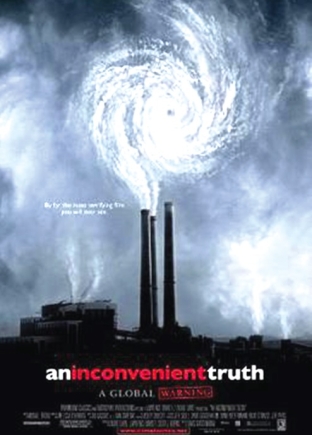
Two decades ago, Al Gore's movie "An Inconvenient Truth" thrust climate change into the global spotlight.
With dramatic imagery and dire warnings, it transformed a niche concern into a front-page crisis, influencing rich country leaders and elite jet-setters, and inspiring a generation of activists.
Twenty years affords distance to reflect not just on the film’s impact, but also its accuracy.
Many of Gore’s most alarming predictions have failed to materialise, while the policy response it helped inspire has proven extraordinarily flawed.
Film
The film's core narrative was that climate change is driving ever-worsening disasters, such as floods, droughts, storms and wildfires.
Yet, over the past century, even as the global population quadrupled, deaths from these climate-related disasters have plummeted. In the 1920s, an average of nearly half a million people died annually from such events.
Today, that number is under 10,000—a decline of over 97 per cent. Richer, smarter societies have made us dramatically safer, proving adaptation and resilience work far better than alarmism suggests.
The film claimed we would see more frequent and stronger hurricanes because of climate change, with the movie poster literally showing a hurricane coming out of a smokestack.
Global data actually show a slight decline in hurricane frequency and their total energy since comprehensive satellite data started in 1980.
Wildfires follow a similar pattern. Globally, annual burned area has decreased by more than 25 per cent over the past quarter century, according to NASA data.
While recent years have seen large US fires because of forest mismanagement, the 1930s Dust Bowl era was five times worse. Fires are down on all other continents.
The film famously highlighted polar bears as a symbol of impending ecological collapse, suggesting they were drowning due to melting ice. In reality, polar bear populations have more than doubled from around 12,000 in the 1960s to over 26,000 today.
The primary historical threat was hunting, not climate change, and Gore’s claims, now 20 years later, have simply turned out to be wrong.
Call
Gore's call to action spurred expensive emissions reductions.
Yet, fossil fuel consumption keeps increasing because cheap and reliable power drives growth, and global emissions have set records nearly every year since 2006.
We’re nowhere near a green transition.
In 2006, the world got 82.6 per cent of its total energy (not just electricity) from fossil fuels, according to the International Energy Agency.
In 2023, the last year with global data, the share was 81.1per cent. On this slow trend, it will take over six centuries to get to zero.
Yet, Gore's message was explicit: climate solutions were already at hand, needing only political will from rich nations to implement them swiftly and decisively.
Although solar and wind technologies have become dramatically cheaper, they remain fundamentally intermittent: they generate power only when the sun shines or the wind blows.
Modern societies require reliable, 24/7 electricity, which necessitates substantial backup systems—typically fossil-fuel plants. People think batteries can play a large role, but almost everywhere, we have battery backup for less than ten minutes.
The result is that we end up paying twice: once for renewables and again for reliable backup infrastructure.
The film's wilfully naïve framing ignored these engineering and economic realities.
The cost of climate policies since 2006 has exceeded $16 trillion globally. In the U.S. alone, the Inflation Reduction Act poured hundreds of billions into green tech.
Yet, emissions climb because the rich world's efforts ignore the reality that developing nations require cheap and reliable energy to reduce poverty.
Rich nations only account for 13 per cent of the remaining 21st-century emissions.
Emerging giants like China, India, and Africa drive the rest.
Even if all rich countries achieved net-zero by mid-century, it would avert less than 0.1°C of warming by 2100, using the UN climate panel’s own model.
Gore’s apocalyptic climate predictions have aged poorly. While climate change is a real problem, the best evidence suggests warming might shave 2-3 per cent off global GDP by 2100.
Context matters: the UN estimates that by century’s end, the average person will be 450 per cent as rich as today.
With climate impacts, they would "only" be 435 per cent as rich.
We're talking about being vastly better off, just slightly less so.
The movie’s biggest blunder was to fail to make the case for smarter approaches.
We need to prioritise innovation. Green tech research and development—to achieve better batteries, advanced nuclear, fusion—could slash costs to make clean energy cheaper than fossil fuels.
Adaptation saves lives cheaply: sea walls, drought-resistant crops, early warnings.
And development lifts billions out of poverty, building resilience.
Two decades on, "An Inconvenient Truth" reminds us that panic is a terrible policy advisor.
Focusing on cost-effective solutions—innovation, adaptation, development—will save trillions and do much more to help both people and the climate.
The writer is President, Copenhagen Consensus/Visiting Fellow at Stanford University's Hoover Institution/author of "False Alarm" and "Best Things First".
