
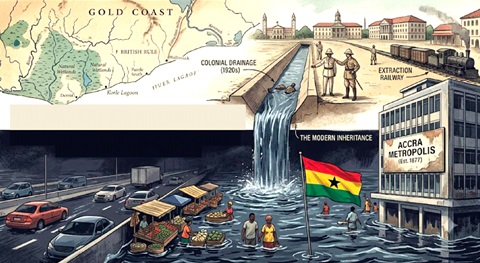
Every rainy season, Accra drowns.
People die not in a remote village, but in the capital of a nation sitting on gold, oil and cocoa.
The usual explanations follow: poor drainage, illegal watercourse structures, and plastic-choked gutters.
All true.
None of it complete.
Beneath every flooded street lies a question nobody in power wants to ask: who designed this city, and for whom?
I blame Britain.
Not as grievance theatre, and not because Ghana carries no responsibility for its own present, but because the foundations modern Ghana stands on in concrete, drainage, and city plan were never designed to serve a thriving African civilisation.
They were designed to administer a colony and move its resources to a port.
Everything else was an afterthought, and Accra’s floodplains are still paying for it today.
The choice is unforgivable
The choice is unforgivable rather than merely careless, because the British knew exactly what they were building on.
The Accra Plains held some of the richest farmland in the territory.
A colonial administration invested in nation-building would have protected it.
Instead, they paved a shipping node directly over it, because farmland does not load onto a cargo ship; raw materials do.
Build a capital on your best soil, and food security and drainage failing together a century later is not coincidence.
It is a design choice whose bill simply took a hundred years to arrive.
The inheritance runs deeper than infrastructure
The British did not build an education system to produce planners or hydrologists capable of redesigning it for a growing nation.
They built one to produce managers, people trained to run a system someone else designed, not to steward land, water, and environment as inheritances owed to the next generation.
Management asks how to keep things running today; stewardship asks what condition a thing will be in two hundred years.
We were trained exhaustively in the first and almost never in the second.
That gap is precisely why so many elites and ordinary citizens alike do not register a blocked gutter or a filled wetland as a threat. It was never in the curriculum.
Britain never drew a five-hundred-year blueprint for Accra, because a city meant to last centuries was never the agenda.
The agenda was raw materials out, dependency in a colony that plans its own long-term infrastructure no longer needs the coloniser.
What got built was sized for extraction on a colonial timeline, not a metropolis meant to stand five centuries later.
We are still living inside drains designed in the 1920s, serving a city forty times larger than the one they were built for, because nobody upstream was ever building for forty times larger. They were building for the next shipment.
The mindset
The deepest inheritance is not concrete at all, it is a mindset, trained into us deliberately: someone else is responsible for your environment.
Everyone waits for government to clean up, as if clean surroundings were a service rendered by the state rather than a discipline practised by a people.
That is not laziness; it is a passed-down psychology of dependency, and it explains why a nation can watch its own capital flood every June and still treat the solution as someone else’s job even when the thing in question is as basic as the air a family breathes in its own compound.
Some will say: stop blaming Britain, the floods are on us now, a fair challenge.
Institutions outlive empires, and so do mindsets.
A drainage system built for a 1920s colonial outpost does not become adequate simply because the calendar changed in 1957, and a dependency psychology does not dissolve simply because the flag changed.
Ghana bears responsibility today for every year since independence that we patched colonial drains and colonial thinking instead of redesigning both from the ground up.
The real question is whether we are honest enough to admit the system beneath our feet, and inside our heads, was never built for the nation Ghana was meant to become.
Western democratic architecture
There is a second inheritance layered on top of the colonial one, and this one is home-grown in its application even if the model was imported: a Western democratic architecture that hands power in four-to-eight-year cycles to leaders who know, from the day they are sworn in, that they will not be there long enough to enforce anything unpopular.
You cannot discipline a nation’s building culture, its waste habits, its wetland encroachment, in a single term and certainly not while campaigning for the next one.
Every flooded gutter in Accra is also a photograph of that structural cowardice, visible in every building erected without a permit, every drain filled in by someone who correctly calculated that no
President facing an election in eighteen months would spend votes stopping them.
An African [resident inside that cycle is rarely positioned to discipline citizens on how they build, because discipline costs political capital today for a payoff a future administration will collect.
So enforcement collapses into its safest form: the photo-op demolition after a disaster, the desilting exercise timed to the rainy season, the emergency task force that dissolves the moment the water recedes.
Nobody within the system is rewarded for stopping illegal construction before it causes flooding; they are rewarded only for being filmed clearing it afterwards.
This is not an argument against democracy itself.
It is an argument that a governance rhythm built for a different climate and history was adopted here without asking whether a coastal capital on colonial-era drains could survive being governed in four-year sprints.
Long-horizon infrastructure needs long-horizon authority insulated from election calendars: a hydrology institution, a planning body, an enforcement arm that outlives whichever president signed it into existence.
Until that exists, every four years resets the discipline clock to zero, and the flood keeps winning the race against the term limit.
Weak foundation
If a house is built on a weak foundation by a builder who never intended it to last five hundred years, repainting the walls will not stop the flooding.
That is precisely what Ghana has done for decades: repainting, dredging, declaring states of emergency, waiting for government, while the foundation itself, colonial-era drainage architecture, extractive economic logic, and the dependency mindset layered on top of both remains untouched.
Britain built a colony’s port on a nation’s best land, trained managers instead of stewards, and left us waiting for someone else to clean up.
We are the ones who must build a nation’s city, and a nation’s mind, to replace it. Until we do, the water will keep telling us exactly where the old foundation still lies beneath the new flag.
