
The Kofi Annan International Peacekeeping Training Centre (KAIPTC) has launched the Department of Applied Research and Innovation in Peace and Security (DARIPS), a new standalone entity created to deepen research output and strengthen policy responses to security challenges across West Africa.
DARIPS will run four programmes: Conflict, Governance and Leadership; Technology and Security; Climate Security and Migration and Peace Operations, Stabilisation and Peacebuilding.
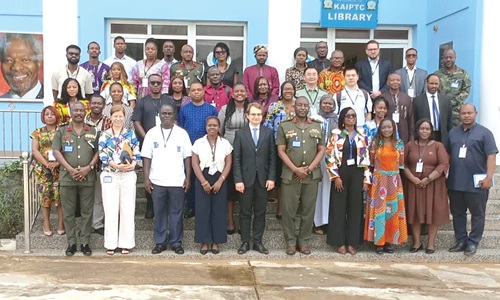
The Programme heads took turns at the event to outline objectives for each area to participants at a Partners' Meeting held at the centre, which brought together officials from KAIPTC's Executive Committee, diplomatic missions, development partners, civil society and private-sector stakeholders.
Plan
Speaking at the event, the Deputy Commandant of KAIPTC, Brigadier General Zibrim Bawah Ayorrogo, explained that the creation of DARIPS stems from the Centre's Strategic Plan for 2024 to 2028, which aims to sharpen institutional structures in response to a fast-changing peace and security landscape.
He said the former Faculty of Academic Affairs and Research had been split into two distinct entities — a standalone Academic Faculty and the new department dedicated solely to applied research and innovation.
"The Department of Applied Research and Innovation in Peace and Security has been established to deepen the centre's research footprint, to sharpen the policy relevance of our work and to ensure that what we produce within these walls speaks directly to the realities you confront in your own institutions, agencies and communities," Brig. Gen. Ayorrogo said.
He explained that West Africa faced a complex security environment, citing the southward expansion of violent extremism from the Sahel, the pressure unconstitutional changes of government have placed on regional institutions and worsening humanitarian and governance challenges.
He said training alone was no longer enough without research to back it.
"Training alone, however well-delivered, is no longer sufficient on its own. It must be matched by rigorous, applied research that translates lived realities on the ground into evidence that can inform policy and guide decision-making at the national and regional levels," he said.
He described KAIPTC's status as an ECOWAS Centre of Excellence as carrying added responsibility to generate knowledge and build institutional capacity for member states navigating a difficult security terrain.
Training
A representative of the German Embassy, Jannis Neubert, commended the centre's decision to elevate research into its own department, describing it as a long-overdue step given research's role in shaping KAIPTC's training, academic, Women, Youth and Peace. Mr Neubert said Germany, through its development agency GIZ and the ECOWAS Peace, Security and Governance project, continue to back joint institutional research between KAIPTC and ECOWAS.
He cited recent German-backed support for a methodology workshop on a joint study into misinformation and disinformation as an example of this collaboration.
He added that research from the centre had previously fed into discussions at the Kofi Annan Peace and Security Forum and informed regional policy conversations, and that the department had existing collaboration with institutions such as the National Defence College and the ECOWAS Commission.
