
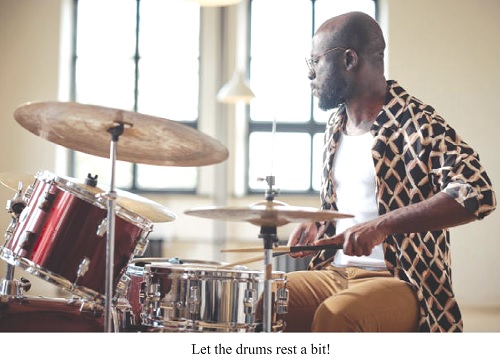
The annual cycle is almost here again—the period of silence and quietude.
The Ga Traditional Council will remind us of the mandatory annual month-long ban on drumming and noisemaking, scheduled for early May to early June.
Our criticism
The first time we received this notice at church, we frowned on it with all kinds of criticism and misgivings, questioning the rationale for such an order.
“How can anybody instruct us to keep silent?” we queried.
“Don’t we have the freedom of self-expression?
Why should anybody tell us not to play drums or make noise in our own church?
Can’t we make a joyful noise unto the Lord?”
Not only did we ask these questions, but we also flouted the instruction with impunity.
So we played the drums and the piano.
Drums Arrested
But halfway through the service, we received the visitors.
They were not at church to worship with us but to effect arrests.
They did not arrest us, but they arrested our drums and keyboards!
At that moment, of course, the noisemaking automatically ceased.
The visitors said they would carry our instruments to the palace and that we must report there to explain why we disobeyed the ban order and pay a fine.
We became sober, buried our complaints, and swallowed our egos.
As we continued the service to the end without the use of drums and keyboards, the reality dawned on us that we don’t always need drums and keyboards to worship the Lord.
From that day on, we announce the ban from the Ga Traditional Council every week throughout the silent month, urging our members to obey the call.
What bothered us at first no longer bothers us.
Even the musical instruments need rest!
Spiritual reflection
Later, we understood that the month-long period is designed to nurture peace, sobriety, and spiritual reflection ahead of the Homowo Festival.
Since we began to accept the ban on noisemaking instead of fighting it, we’ve noticed how quietude stimulates contemplation.
Let’s face it: sometimes the drums, keyboards, trumpets, and loud music rather deprive us of the calmness needed for meditating on God’s Word and focusing on Christ.
In evangelical Christian circles, our personal devotional moment is known as the quiet time, emphasising the need for serenity in the presence of God.
Making faith relatable
Christianity’s history includes borrowing certain traditional or local festivals for worship.
Secular holidays, fiestas, carnivals, and events have been positively adopted for Christian celebrations.
These include Christmas (Yuletide), Easter, St. Valentine’s Day, and other traditional days that were taken over by the church as a strategy to make the Christian faith more relatable to new converts.
Therefore, since the church wouldn’t celebrate the traditional Homowo, it can safely adopt the silence that precedes the festival. A month of silence for Christian meditation should be a welcome idea.
The church may be accused of being syncretic (blending Christianity with other faiths), but looking for ways to carefully and prayerfully promote inclusivity in order to position the church for growth cannot be sacrilegious.
Seminar silence
We were in Pretoria to attend a seminar for writers. Our host, a South African war veteran who had built a conference centre far away in the countryside, issued a weird instruction from day one.
“There shall be no talking from 6 a.m. to 9 a.m. every morning,” he said.
Explaining, he insisted that before the seminar began at 9 a.m. each day, we were to keep total silence: no greetings, no private or public singing, no conversation, and not even whistling.
Some of us initially grumbled over such a bizarre instruction.
But three days into the weeklong programme, when we got used to the three-hour ban on noisemaking, we started enjoying it!
With a cup of coffee in hand, we sat quietly by ourselves and enjoyed our personal solitude.
So there is certainly something good and refreshing about shutting up and listening to our innermost thoughts.
A proverb states that even a fool is considered wise when he keeps silent (Proverbs 17:28).
God in the silence
Remember the prophet, Elijah? When the Lord was about to pass by, so the prophet would experience His presence, a strong windstorm tore the mountain apart and shattered the rocks. But God was not in the storm.
After the wind came the earthquake—another noisy phenomenon, but the Lord was not in the earthquake.
Neither was He in the crackling fire that followed the earthquake.
So how did Elijah experience the Lord? We learn from 1 Kings 19:12: “After the fire came a gentle whisper (or a still small voice).”
Thus, God spoke to the prophet in a quiet moment.
One day, our pastor told us, “Please, when you arrive at church, minimise the socialising and quietly sit down to meditate, so you can hear God speaking.”
There is, indeed, power in silence.
The writer is a publisher, author, writer-trainer and CEO of Step Publishers. E-mail:
