
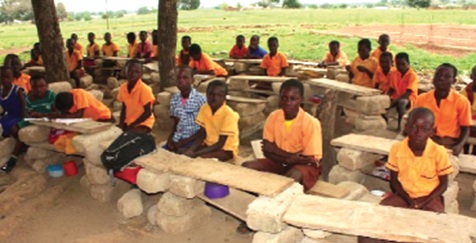
Across Ghana, the signs are becoming increasingly familiar.
By mid-morning, classrooms grow stifling. Pupils wave exercise books in place of fans, teachers shorten lessons, and attention wanes under oppressive heat.
What once felt like seasonal discomfort has now become a structural challenge to education, driven by rising temperatures, climate change and environmental degradation.
Ghana has been warming steadily since the 1960s. Recent climate assessments show a sustained rise in average temperatures, with heat intensifying during the dry season. In 2025 alone, Ghana recorded its second-warmest year since the early 1990s.
Extreme heat days and warmer nighttime temperatures are becoming more frequent, increasing heat stress during everyday activities, including teaching and learning.
For schools, especially public schools in vulnerable regions, the implications are profound.
Northern Ghana: Learning under extreme heat
Northern Ghana has emerged as one of the fastest-warming parts of the country.
Cities such as Tamale, Wa, Navrongo and Bolgatanga now frequently record daytime temperatures between 38°C and 41°C during the dry season, with March often the hottest month.
Projections suggest that temperatures in the region will rise further in the decades ahead.
Yet many schools in the north were never designed for such conditions.
Typical classroom blocks have zinc or asbestos roofing, no ceilings, limited cross ventilation and bare compounds devoid of trees.
As the day wears on, heat builds up in classrooms, turning learning spaces into miniature furnaces.
Teachers report that afternoon lessons during the peak dry season are often ineffective. Pupils struggle to concentrate, reading becomes laborious and participatory teaching methods are difficult to sustain.
Heat does not merely cause discomfort; it quietly erodes instructional time, learning outcomes and teacher morale.
Trees as simple, powerful solution
Amid complex national debates on climate change and education reform, one solution stands out for its simplicity and effectiveness: tree growing in school compounds.
Scientific evidence consistently shows that trees cool their surroundings through shading and evapotranspiration.
Tree canopies block direct sunlight from walls and roofs, while moisture released from leaves cools the surrounding air.
In practical terms, shaded areas can be several degrees cooler than exposed spaces.
For schools, this difference is transformative.
Tree planting around classroom blocks reduces indoor heat, improves comfort and allows outdoor learning even during the dry season.
Schools with established shade trees report calmer learning environments and greater use of outdoor spaces for reading, group work and assemblies.
Importantly, this intervention is affordable and locally manageable.
Trees are not mechanical devices that require constant energy input.
Once established, they provide cooling benefits year after year.
Why fruit-bearing trees matter
Trees growing in schools should not be limited to shade alone.
The deliberate inclusion of fruit-bearing trees, such as mango, guava, citrus, cashew, shea and avocado, adds crucial nutritional and educational value.
Fruit trees support better child nutrition by improving access to fresh fruits, thereby enhancing health, memory, and concentration.
They also serve as “living classrooms”, giving pupils hands-on exposure to tree care, harvesting and environmental stewardship.
In some cases, harvested fruits can supplement school feeding programmes or be shared with surrounding communities under agreed arrangements.
In many Ghanaian towns and villages, fruit trees planted in schools quickly become shared assets.
They strengthen community ties and reinforce the idea that schools are public institutions that serve society beyond formal teaching hours.
Schools as community spaces
In Ghana, school compounds are more than places of instruction.
They often double as community spaces, especially where formal parks or community centres are limited.
Well-shaded school environments support funerals and family gatherings, religious services, town hall meetings, and political activities.
Trees provide natural, dignified shade that reduces heat stress, improves comfort and enhances safety during long outdoor events.
In this sense, tree growing does more than support learning. It strengthens social cohesion, supports civic life and enhances the social value of public education infrastructure.
Equity, Climate Justice and the Cost of Inaction
Heat does not affect all schools equally.
Well-resourced institutions often have fans, air conditioning and landscaped compounds.
Public schools in rural and peri-urban areas rarely do. For these schools, trees may be the only viable cooling infrastructure.
Failing to adapt learning environments to rising temperatures risks widening educational inequalities.
Supporting school-based tree growing is, therefore, about climate justice as much as environmental protection.
Why public support matters
Recognising these realities, the Forest Plantation Development Fund (FPDF) Management Board has outlined a bold initiative to integrate shade-providing and fruit-bearing trees into school compounds, particularly in climate-stressed regions such as Northern Ghana.
This initiative links climate adaptation with education, nutrition and community development. But its success depends on broad public backing, from communities, traditional authorities, Parent-Teacher Associations, Metropolitan and District Assemblies, civil society, and the private sector.
Trees take time to grow, but when planted today, they shade generations tomorrow.
Supporting the FPDF’s school greening initiative is an investment in cooler classrooms, healthier children and stronger communities.
In a warming Ghana, this is no longer optional; it is essential.
Forest Plantation Development Fund
The FPDF is a statutory public fund established to promote sustainable forest plantation development in Ghana.
Its mandate includes:
• Financing afforestation and reforestation initiatives;
• Supporting community and institutional tree planting programmes;
• Promoting environmental sustainability, climate resilience and green livelihoods; and
•Strengthening the social and economic benefits of forestry for present and future generations.
Through its proposed school-based tree-growing initiative, the FPDF Management Board seeks to align education, climate adaptation and community development, ensuring that Ghana’s schools are not only centres of learning but also anchors of environmental stewardship.
