
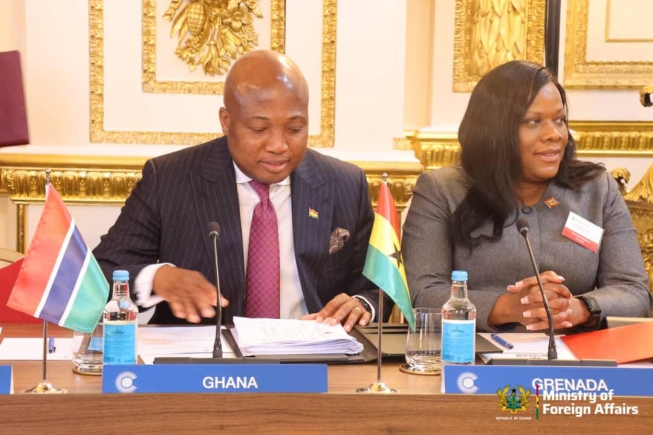
The Minister of Foreign Affairs, Samuel Okudzeto Ablakwa, has called on the Commonwealth of Nations to condemn recent attacks on United Nations peacekeepers in Lebanon and urged member states to work towards removing tariffs and trade barriers within the bloc.
Speaking at the 26th Commonwealth Foreign Affairs Ministers’ Meeting in London on Sunday, March 8, 2026, Mr Ablakwa warned that attacks on UN peacekeepers could undermine global peacekeeping operations and the principles of multilateral cooperation.
His comments follow an attack on the Ghana Battalion (GHANBATT) headquarters, known as “Camp Obeng”, in southern Lebanon last Friday evening during an exchange of fire between the Israel Defence Forces and Hezbollah.
The Minister described the attack on the Ghanaian base, which left three Ghanaian soldiers in critical condition, as an assault on the principles of the UN Charter and called for a full investigation.
“On our way in, our peacekeepers in Lebanon were attacked. As we speak, three of them have undergone multiple surgeries. An attack on UN peacekeepers is an attack on multilateralism. It is an attack on every principle that the UN Charter exists to defend.
“So, we urge the Commonwealth to roundly condemn this attack and to demand immediate investigations so that peacekeepers will know that the sacrifices they made, leaving their families, their children, staying in harm's way to maintain global peace and stability, means something to us and that we will not countenance such untoward and unwarranted attacks.
“We have demanded investigations and we hope that the United Nations will act promptly,” he said.
Meanwhile, the government of Ghana has petitioned the UN Secretary-General, António Guterres, to initiate investigations into the attack and ensure accountability for those responsible for the assault on Camp Obeng.
Tariff barriers
Mr Ablakwa also urged the Commonwealth to pursue the removal of tariffs and trade barriers among its member states to enhance economic cooperation within the bloc.
According to him, eliminating trade barriers among the Commonwealth’s 56 independent countries across Africa, Asia, the Americas, Europe and the Pacific could create a vast market of about 2.7 billion people and deepen economic collaboration.
The Minister said such a move would also allow member states to leverage opportunities under the African Continental Free Trade Area (AfCFTA), whose secretariat is hosted in Accra.
“We hope to share our thoughts, particularly in offering the Commonwealth as a different multilateral organisation that does not believe in tariff wars, but will remove tariffs and trade barriers and ensure that we are able to enhance our fortunes as we pursue economic diplomacy, particularly as Ghana hosts the African Continental Free Trade Area Secretariat,” he said.
He, however, commended the Commonwealth for outlining reform initiatives aimed at strengthening the organisation and benefiting member states.
UN resolution
The Minister also called on Commonwealth countries to support a resolution to be tabled at the United Nations General Assembly seeking to recognise the transatlantic slave trade, slavery, colonisation and apartheid as the greatest crimes against humanity.
The resolution, which is expected to be presented at the UN on March 25 this year by President John Dramani Mahama, also calls for reparations and reparative justice for African countries and members of the Commonwealth.
Mr Ablakwa appealed to member states to rally behind the initiative ahead of the vote scheduled for March 25, describing it as a critical step towards global acknowledgement of historical injustices and the pursuit of reparative justice.
He said the initiative had already received backing from the African Union and expressed confidence that Commonwealth countries would lend their support.
“We know that we can count on the Commonwealth for reparative justice and restitution in this matter,” he said.
The proposed resolution forms part of broader international efforts to acknowledge the enduring consequences of more than 400 years of the transatlantic slave trade, during which over 15 million African men, women and children were forcibly taken to North and South America, the Caribbean and Europe to work on plantations and in other industries.
Historical records indicate that an estimated two million enslaved people died during the transatlantic journey.
Meanwhile, March 25 has been designated by the United Nations as the International Day of Remembrance of the Victims of Slavery and the Transatlantic Slave Trade.
