
Canada was among the first countries to recognise Ghana’s independence in 1957 and established its very first African bilateral development programme in Ghana shortly thereafter.
Since then, Canada has kept a close friendship with the people of Ghana and has worked together in global forums to advance shared values, and provided more than 2.5 billion dollars in development assistance to Ghana in support of priorities defined by Ghanaians themselves.
Ghana is Canada’s fifth-largest bilateral trading partner in Sub-Saharan Africa, and the eighth-largest trading partner on the continent as a whole and a two-way merchandise trade between the two countries reached about 483 million dollars in 2024, with Canadian exports such as cereals and vehicles and imports, including cocoa and soya beans.
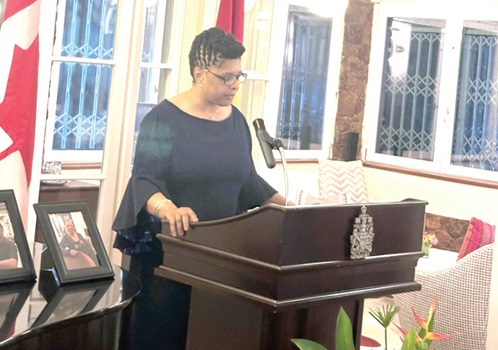
The Canadian High Commissioner to Ghana, Togo and Sierra Leone, Myriam Montrat, at a media engagement hosted at her official residence in Accra, to brief the media about Canada’s bilateral relationship with Ghana, as well as its work and priorities and how they fit in Canada’s broader relationships with Africa and the world.
She outlined a forward-looking vision of the Canadian Government for its strategic partnership with Ghana for shared security and continuous support for inclusivity and sustainable economic growth, especially for women and the youth.
The Media
While commending the Ghanaian media for its critical role in enforcing accountability, empowering citizens, and ultimately promoting development, she noted that “Ghana’s media landscape is a cornerstone of this country’s democracy and an essential partner for all of us who care about transparency, accountability and informed public debate, adding that there is no strong democracy without a strong, independent media.
Canadian mining assets in Ghana are valued at over $1.1 billion, providing a strong foundation for growth. Both Ghana and Canada possess rich deposits of critical minerals and extensive expertise in the mining sector, creating a solid basis for continued collaboration and development.
To foster inclusive economic growth, Canada is investing in youth entrepreneurship, particularly for young women and men in agribusiness and the green economy.
Our partners are helping micro, small and medium enterprises access finance, improve business skills and connect to markets – including opportunities linked to the African Continental Free Trade Area, whose Secretariat is right here in Accra.
They are also highly active in the Technical and Vocational Education and Training (TVET) sector, working to tackle youth unemployment and ensure that training aligns with industry needs.
This prepares young Ghanaian women and men for the labour market, with Canada contributing CA$30 million to the TVET sector over the past seven years.
In this, we are guided by our deep commitment to equality and equal opportunities, and by Ghana’s own vision. Turning to trade and investment, Canadian companies are contributing knowledge, technology and innovation to support Ghana’s sustainable development of natural resources.
Trade Service
Through its Trade Commissioner Service, they help Canadian and Ghanaian businesses connect in sectors such as clean technology, infrastructure, information communication and technology, sustainable mining and agri-food and continue to work diligently to strengthen its partnership with Ghana by advocating for policies that promote a more investment-friendly environment.
Through collaboration with government institutions, private sector stakeholders and development partners, Canada supports initiatives that foster transparency, economic stability and innovation. Through development cooperation, we are strengthening Ghana’s health systems, empowering women and girls, and fostering inclusive economic growth:
Health sector support
In the health sector, Canada, as one of Ghana’s top bilateral donors, has supported the roll-out of free primary health care and has helped about four million people, mostly women, gain access to modern sexual and reproductive health services, while its nutrition programming has benefited 2.5 million adolescent girls.
“Through our Women’s Voice and Leadership project, Canada supported a Ghanaian women’s rights organisation that played a central role in bringing about the Affirmative Action-Gender Equality Law in 2024, and we are supporting its implementation, including through assistance to local-level governance institutions”.
Peace and security
Through diplomacy and security cooperation, Canada is working together with Ghana to promote peace and security, gender equality, democracy, human rights and regional stability.
“We are especially proud of our collaboration with the Ghana Armed Forces through the Elsie Initiative, advancing the meaningful participation of women in UN peace operations – a cause where Ghana’s leadership shines on the global stage”.
Ghana and Canada have maintained long-standing cooperation through military training programs and joint border security initiatives, helping to combat trafficking while facilitating legitimate trade, thereby reinforcing Ghana’s role as a pillar of regional stability.
These efforts aim to create conditions that attract sustainable investment, promote entrepreneurship, and open new opportunities for trade and growth within Ghana’s dynamic economy.
The High Commission celebrated a major success with Air Transat, one of Canada’s major airlines, announcing the launch of a new non-stop route between Toronto and Accra.
This will be a seasonal service that offers two weekly flights between June 17 to October 22, 2026.
This first-ever direct air link between Canada and Ghana will help bring the two countries even closer by making tourism, business travel, educational and cultural exchanges in both directions much more convenient, just in time for the FIFA World Cup 2026.
And this is just the beginning, as the Air Transport Agreement (ATA) signed between Canada and Ghana in March 2025 allows for up to 14 weekly passenger flights and 10 weekly cargo flights by multiple carriers.
Democratic institutions
The High Commission of Canada relies on bridges to continue advancing mutual prosperity, strengthening democratic institutions, and supporting innovation, but we find ourselves in a world of profound change.
The challenges we face from economic uncertainty to global instability are real and to step up to these challenges and ensure we remain a strong, dynamic and secure country, Canada is refocusing its foreign policy on two main priorities: trade diversification and peace & security partnerships.
In Africa, this is supported by a new Africa Strategy launched earlier this year, titled A Partnership for Prosperity and Shared Security.
It aims to enhance security cooperation and commercial ties that benefit Canadians and Africans alike, founded on peer-to-peer partnership and strong people-to-people ties.
