
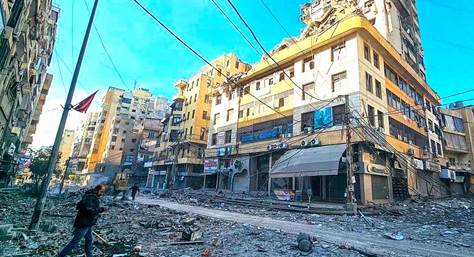
As the bombardments continue between the United States, Israel and the Islamic Republic of Iran, much of the global commentary has centered on geostrategic calculations, sense and sensibilities of the war and regional power dynamics among other analyses.
All attempting to make sense of an insensible war. Yet for Africa, a crucial reality remains: wars fought elsewhere rarely remain “elsewhere” for long. No one thought at the beginning of the Russian-Ukranian war that ordinary Ghanaians would find themselves in the frontline of the conflict against their wish.
Most African nations
But such is the fog of war. Most African nations are already grappling with inflation, debt distress, food insecurity, and fragile security environments.
The escalation we are witnessing is not a distant spectacle, it has a high potential of sending an economic and geopolitical shockwave across the continent (and globally). Oil prices may spike. Supply chains could tighten.
Fertiliser costs may climb. Grain markets may wobble. The most vulnerable communities far removed from Tehran, Tel Aviv, or Washington may feel the tremors of this war stronger.
However, beyond the economics lies a deeper concern for the current international order: the normalisation of preemptive war. Many African states emerged from colonial subjugation with a profound sensitivity to sovereignty and non-interference.
Continental order
The post-independence continental order was built on the principle that borders, however imperfectly drawn, should not be violated by external force.
When powerful states justify military incursions as necessary security measures, it reopens difficult questions about international law and unequal enforcement.
Whose security justifies war? Whose sovereignty is negotiable and whose is not? Whose citizens qualify for R2P(responsibility to protect) and whose do not?
From Accra to Addis Ababa, governments and policymakers must weigh the implications carefully.
The erosion of multilateral diplomacy in favour of unilateral military action weakens the very frameworks small and mid-sized states rely upon for protection (most of whom are on the African continent).
If global norms bend under geopolitical pressure, the Global South disproportionately bears the major share of the consequence.
The continent’s history
There is also a moral dimension Africa cannot ignore.
The continent’s history—marked by proxy wars and Cold War entanglements—offers painful lessons about how great-power rivalries can destabilize entire regions for generations.
The fog of war obscures not only battlefield realities but long-term human consequences: displaced families, traumatized youth, shattered infrastructure, and hardened resentments.
The expansion of this ongoing conflict risks igniting broader regional actors and non-state militias, further destabilising already volatile corridors.
For African countries with diasporic communities across the Middle East, the safety of citizens abroad becomes an urgent concern.
Governments must prepare evacuation frameworks, strengthen diplomatic channels and safeguard remittance flows that many households depend upon.
African Union
The African Union also faces a defining moment. Africa has increasingly sought a stronger collective voice in global governance.
Silence in the face of this escalating war risks reinforcing perceptions of marginality.
A principled call for de-escalation, ceasefire and renewed diplomacy would align with the continent’s long-standing commitment to peaceful conflict resolution.
None of this requires sophisticated capabilities about security threats or geopolitical realities.
States have legitimate concerns about regional stability and defence.
Yet, legitimacy is not a substitute for proportionality, nor is strategic interest a moral blank cheque.
War, once unleashed, rarely confines itself to its declared objectives.Indeed, Clausewitz rightly described war as ‘the realm of uncertainty.’
For Africa, the question is not which side to endorse.
It is whether a world increasingly comfortable with force serves the long-term interests of emerging regions striving for development, stability and voice.
Global labour markets
The continent’s youth population projected to shape global labour markets and innovation trajectories in coming decades—needs investment, education and opportunity, not another era of geopolitical volatility that diverts global attention and resources toward destruction.
The insensibility of this war is not only confined to the sufferings and killings of the innocent civilians whom the war claims to liberate but also most Americans who do not wish for their tax payers money to be spent on this war.
Their president promised them peace but offers them wars or not so called wars but show of military superiority in the world. The war is insensible because it appears Mr Trump himself did not like the idea.
What changed? It is insensible that the most sophisticated military in the world would think that killing the spiritual leader would be the magical catalyst for a sudden regime change. Just like that?
Missiles and manoeuvres
Well, for us in Africa, our concern expands beyond missiles and manoeuvres to include market women in Lagos or Accra facing rising food prices, students in Nairobi or Uganda coping with inflation, and migrant workers from diverse African countries in the Gulf states fearing sudden displacement due to the fog of war extending into the territories where they seek decent livlihoods.
The cost of a sophisticated missile could turn around most African economies for the better.
Africa’s voice in this moment should be clear: sovereignty matters, civilian protection matters, diplomacy matters.
If the fog of war clouds moral clarity elsewhere, the African continent—shaped by its own hard-earned lessons—can insist on remembering what prolonged conflict always teaches too late: violence may demonstrate power, but it rarely delivers peace.
