
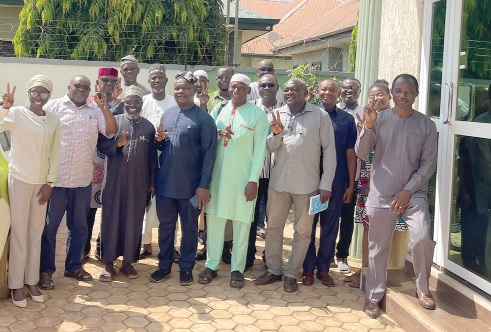
Standardised Islamic curriculum needed to curb radicalisation among youth — Study recommends
Research conducted by the West Africa Network for Peacebuilding (WANEP), Ghana, has recommended the integration of a standardised Islamic curriculum into Ghana’s educational system to help prevent the possible spread of violent extremism and radicalisation among the youth.
The study stressed that although the Islamic school system, also known as a madrassah, plays a vital role in religious education, the lack of a unified and standardised curriculum poses a risk, as it allows for varying interpretations of Islamic teachings that could expose students to extremist ideologies.
According to the findings, some youth in Ghana have been radicalised by violent extremist groups and, in some cases, killed by the same groups that recruited them.
The report further revealed that many of those radicalised had Islamic education backgrounds, but a limited understanding of Islam, making them vulnerable to manipulation.
Standardised curriculum
Presenting findings of the research at a stakeholders’ conference in Tamale, a PhD Fellow at the Kofi Annan International Peacekeeping Training Centre (KAIPTC), Mustapha Abdallah, pointed out that a standardised curriculum would make it easier for the government to monitor Islamic education and reduce radicalisation risks.
He also called for stronger interfaith dialogue between Muslims and Christians to promote national cohesion and mutual understanding.
“Since radicalisation has become a major problem within the sub-region, it is important that the government continues to monitor activities within the madrassah system, especially those located in remote areas where there are no monitoring mechanisms,” he said.
Mr Abdallah urged the government to ensure that all madrassahs were registered under the Islamic Education Unit to enable effective supervision and curriculum regulation, adding that regular curriculum reviews were necessary to prevent the inclusion of teachings that could promote radical thoughts.
Project
The study, which forms part of WANEP’s Action for Peace Network (RECAP) Project funded by the European Union (EU), seeks to address the challenge of potential radicalisation in Ghana and explore whether the madrassah system could inadvertently contribute to violent extremism.
It also seeks to strengthen the system’s capacity to nurture young people into responsible and peace-loving adults.
The RECAP Project aims at establishing a sustainable and inclusive regional network of peacebuilding experts across West Africa and the Lake Chad Basin to promote collaboration and prevent conflict and violent extremism.
University Oversight
For his part, A lecturer at the Kwame Nkrumah University of Science and Technology (KNUST), Professor Yunus Dumbe, observed that the rise in violent extremism was partly due to the lack of supervision and mentorship for students on university campuses.
He explained that while madrassahs maintained strict discipline, university environments are more liberal, which could create spaces where extremist ideologies might thrive if unchecked.
He added that “it is important to have a harmonised policy on university chaplaincies in Ghana to promote student discipline and responsible religious engagement”.
Commendation
The National Network Coordinator of WANEP-Ghana, Albert Yelyang, commended the researchers for their insightful contribution to peacebuilding efforts and called for concerted efforts to promote stability in the country.
Writer’s email:
