

Teacher postings: Prioritise teachers’ local language proficiency — Prof. Abroampa
The immediate past Dean of Education at the Kwame Nkrumah University of Science and Technology (KNUST), Professor Winston Kwame Abroampa, has stressed the need to ensure that teachers' local language proficiency influences their postings.
That, he said, was because the current teacher deployment system did not effectively match teachers with their proficient languages, leading to mismatches.
He said that while teachers indicated their proficiency in Ghanaian languages on posting forms, it did not significantly influence postings.
He suggested that reviewing the teacher deployment policy would also help ensure adherence to the Ministry of Education’s directive on the compulsory use of the mother tongue as the medium of instruction in public basic schools, from kindergarten to primary three.
Prof. Abroampa was speaking at a National Stakeholder Engagement on a project titled “Impact of Culturally Responsive Teaching Practices on Social and Emotional Development in Diverse Early Childhood Classrooms in Ghana”.
Project
The project was funded by a $500,000 grant from the International Development Research Centre (IDRC) in Canada.
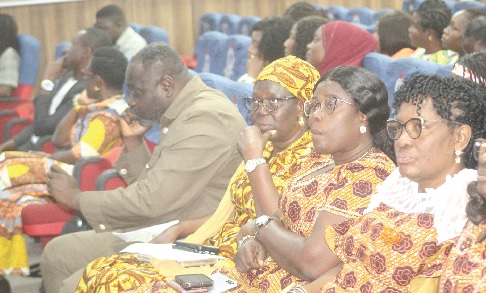
The participants in the National Stakeholder Engagement
The project is implemented by the Kwame Nkrumah University of Science and Technology and supported by the Global Partnership for Education Knowledge and Innovation Exchange (GPE-KIX).
The two-year project was started in July 2024, aimed at enhancing social-emotional learning through culturally sensitive teaching methods.
It was aimed at addressing capacity-building needs, policy implications, the development of early childhood curriculum and teacher education programmes.
It was implemented in eight schools, each in the Ashanti and Greater Accra regions.
At the meeting in Accra last Wednesday, Prof. Abroampa, who is also the Technical Lead for the project, said the baseline findings revealed that many teachers were not familiar with culturally responsive pedagogies, and often used the English Language in teaching despite policy recommendations for local languages to be used.
He explained that culturally responsive pedagogies involved teaching and learning practices that respected the diverse linguistic and cultural backgrounds of young learners.
As part of the findings, he said, parents often equated proficiency in English with intelligence, putting pressure on teachers to use the English language.
Another observation from the project showed that in linguistically diverse classrooms, children who understood the local language became peer interpreters for their classmates, raising concerns about the accuracy of information being communicated and the potential for misunderstandings.
Student confidence
The Ashanti Regional Education Director, Dr William Kwame Amankara Appiah, commended the research team and said the project, when scaled up, would help early learners to integrate better in early childhood classrooms.
He said the benefits of teaching in the mother tongue improved student confidence and helped them understand and speak their native language fluently.
