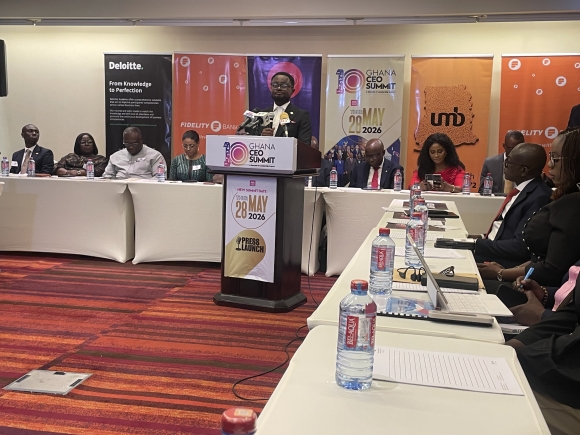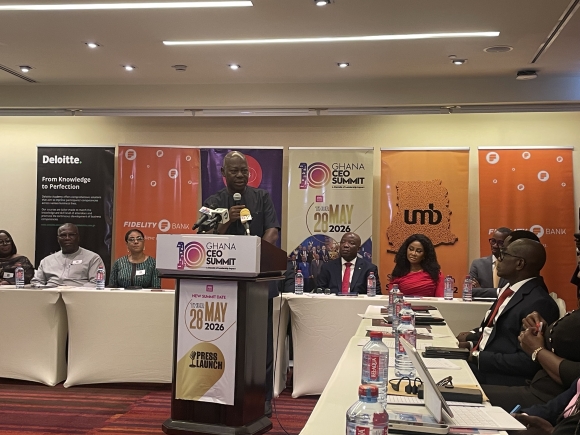
Ghana CEO Summit 2026 launched with call for bold business reset
The 10th Ghana CEO Summit & Expo 2026 has been officially launched ahead of its scheduled date of May 28, 2026, with a strong call on Ghanaian businesses to abandon outdated management models and adopt strategies built on resilience, localisation and protection against global shocks.
The summit, to be held under the theme “Accelerating Ghana’s Economic Transformation: Driving Bold Reforms through Leadership, Technology, and Industrialisation – From Vision to Action,” aims to provide strategic insights, deepen high-level dialogue, strengthen public-private collaboration, and unlock new opportunities for investment, partnerships and growth.
Call for strategic reset
Speaking at the launch, the Chief Executive Officer of Margins Group, Moses Baiden Jnr, cautioned that businesses can no longer rely on traditional assumptions of guaranteed access to global markets.
“We cannot continue to treat business as we have in the past,” he said.
He urged companies to move away from passive dependence on international supply chains and instead invest in building local capabilities that protect economies, institutions and livelihoods.
Mr Baiden Jnr stressed that resilience must be anchored in localised production and supply systems, enabling firms to maintain control over outcomes.
He highlighted “value addition, import substitution and food sufficiency” as critical priorities for both business and policy direction.
Strengthening value chains
Mr Baiden Jnr further advocated an integrated business approach that combines technology, manufacturing and public-private partnerships to ensure quality and continuity.
“If you want quality, continuity, security and long-term resilience, you have to build capability across as much of the value chain as responsibly possible,” he stated.
He called for stronger policy and regulatory support to enable capable private sector players to expand and drive industrialisation.
“We need to empower them. We need to put policy frameworks that allow them to build competency and the regulatory environment to allow the private sector to fill the part that government can,” he added.
From dialogue to delivery
The Founder of the summit, Ernest De-Graft Egyir, reflected on its evolution over the past decade, noting that it had transitioned “from dialogue into influence.”
He pointed to measurable impacts across ten strategic pillars that have enhanced policy coordination, governance and investment visibility.
However, he stressed that the next phase must prioritise execution.
“After ten years of dialogue, Ghana must now enter a decade of execution, accountability and measurable transformation,” he said, urging a shift “from policy formulation to implementation, from intent to delivery, from ambition to result.”
He called for renewed national commitment, adding: “Let us recommit ourselves to a single national direction. Let us move from vision to action.”
Focus on implementation and leadership
The Chief Executive Officer of the Volta River Authority, Edward Ekow Obeng-Kenzo, described the summit as a critical platform for advancing leadership, technology, industrialisation and corporate governance reforms.
Speaking in the context of the VRA’s 65th anniversary, he said the organisation had “remained resolute, consistent and reliable” in delivering power, and pledged to “remain committed to delivering reliable electricity for all.”
He also highlighted the authority’s expanded role across sectors including hospitality, healthcare, education and water transport, all contributing to industrial growth and national development.
Mr Obeng-Kenzo underscored the urgency of translating plans into tangible outcomes.
“we have moved from ambition to delivery,” he said, urging leaders to demonstrate patriotism and take ownership of the country’s transformation agenda.
“Let us all… roll up our sleeves and change the course of this country,” he added.