
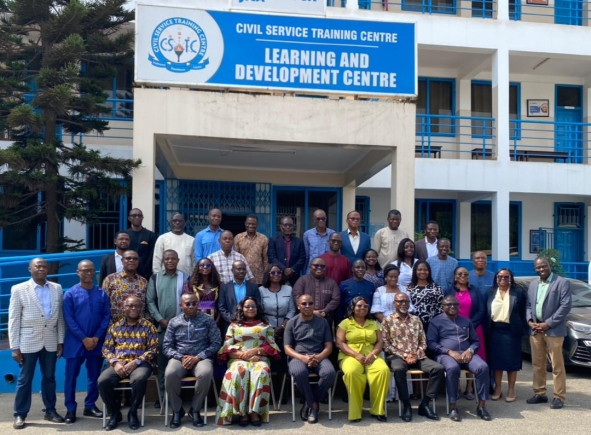
Senior management staff of the Ghana Highway Authority (GHA) have undergone a two-day training programme on ethics and teamwork aimed at strengthening productivity and improving service delivery within the organisation.
The training, organised by the Civil Service Training Centre (CSTC), seeks to promote ethical leadership and foster stronger collaboration among the authority’s top officials.
The programme, which began on March 3, is expected to equip participants with practical skills to demonstrate ethical leadership, mobilise teams effectively and drive productivity within the authority.
Focus on ethics and teamwork
The Chief Executive Officer of GHA, Issah Ishak, speaking at a brief opening ceremony, said although the authority regularly organised technical training for its engineers and staff, the focus on ethics and teamwork represented a significant shift.
“This is a bit off the tangent because it is not a clinical training,” he said, adding that ethics and teamwork were important for the development of any organisation moving forward.
He urged participants to take the programme seriously, noting that in his 31 years with the authority, it was his first time attending a training programme focused specifically on ethics and teamwork.
Mr Ishak said the knowledge gained from the training would prove invaluable, particularly for staff who would later rise to more senior management positions.
Effective management beyond technical skills
The Acting Deputy Chief Executive (Administration) of GHA, Paul Y. A. P. Duah, said effective management extended beyond professional and technical training and required deliberate attention to how people related and worked together.
“This time we are taking a very close look at what happens in between people. We are talking ethics. We are talking leadership,” he said.
He explained that ethics, leadership and teamwork formed the “capping” of any sound management system and would help improve performance within the authority.
He also encouraged management and executive staff to approach the training with seriousness, describing it as fundamental to the authority’s performance going forward.
Strengthening ethical leadership
The Principal of the Civil Service Training Centre, Dora Dei Kumi, said the training was necessary because engineers often focused on technical expertise, whereas leadership required strong soft skills such as integrity, accountability and the ability to inspire teams.
She described roads as the “artery of the economy”, explaining that highways connect businesses, facilitate access to health care and support overall national development.
“They have a pivotal role to play in making the economy work, and ethical and team-oriented leadership at GHA would ultimately translate into better outcomes for citizens,” she said.
Commendation for GHA management
Mrs Kumi commended the management of the Ghana Highway Authority for prioritising capacity development and sponsoring 137 officers to participate in the programme.
She explained that although the centre was originally established to serve the Civil Service, it had expanded its scope to support other public sector institutions whose training needs were not fully met.
Mrs Kumi added that the centre’s approach to training went beyond classroom instruction, placing strong emphasis on practical application and measurable results.
“At the Civil Service Training Centre, we don’t get our training to end in the lecture hall. We visit you in your respective offices to find out what it is that you did with the training,” she said.
Participants, she said, would be required to develop action plans outlining how they intend to apply the knowledge and skills acquired during the programme.
The Principal added that the centre would follow up within three to six months after the training to assess how participants had implemented the lessons learnt.
