
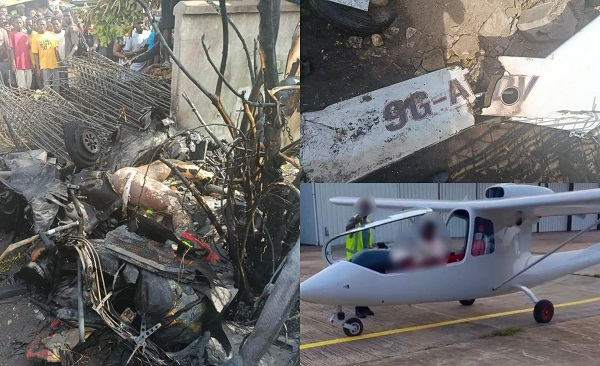
The Aircraft Accident and Incident Investigation and Prevention Bureau (AIB Ghana) has stated that the fatal aircraft crash at the TMA Day Care School at Tema Community One on March 16, 2026 was most likely caused by engine failure resulting from overheating.
The Bureau said the altitude at which the aircraft engine failed was also too low for the pilot to find and execute a safe landing.
Presenting the findings of the final report on the investigation into the accident involving the Sky Arrow 650T microlight aircraft with registration 9G-ADV at a press briefing in Accra on Tuesday (May 26, 2026) the Investigator-in-Charge, Captain Paul Forjoe, confirmed that the pilot was licensed and qualified to operate the aircraft in line with existing regulations.
However, he said investigators found that on all three flights conducted from Ho Airport on March 16, the pilot occupied the rear seat while his friend and brother sat in the front pilot’s seat.
He said the arrangement breached the conditions of the aircraft’s flight permits and restricted the pilot’s access to critical instruments, warning lights and switches.
Permits
He said the investigations further established that all three flights undertaken from Ho Airport on the day of the accident were unauthorised because the aircraft did not possess a valid permit for the operations.
He said both Air Traffic Control (ATC) and the management of Accra and Ho airports were also unaware of the details and conditions attached to the flight permits issued to the aircraft.
He added that the aircraft had no nominated maintenance facility or personnel responsible for its upkeep.
“There are no records available of any maintenance action on the aircraft between January 14, 2026 and the last flight of March 16, 2026, during which 15 flights were executed,” he said.
No distress call
Captain Forjoe also indicated that there were no distress call or emergency declaration made prior to the crash.
Additionally, he said ATC failed to notify AIB Ghana of the accident as required under Section 22(1c) of the Aircraft Accident and Incident Investigation and Prevention Bureau Act, 2020 (Act 1028).
He said the investigation identified several contributory factors, including the failure to address engine malfunctions detected at Ho Airport, and distractions caused by persistent communication on the pilot’s cellphone.
Contributing factors
Captain Forjoe explained that the aircraft had a test flight permit which authorised the aircraft to operate from Accra to Accra and a ferry flight permit which authorised the aircraft to fly only from Accra to Ho.
He said the pilot's decision to fly from Accra to Ho and back was not in conformity with the flight permit received from GCAA since no flight permit had been issued for the return flight.
He also explained that a witness account of white smoke emanating from the aircraft engine was not addressed after the aircraft performed a short flight (13 minutes) at Ho that had the pilot’s friend in the pilot's seat.
Recommendation
The Lead investigator urged the GCAA to strengthen oversight of general aviation operations and ensure that approved maintenance providers for aircraft were properly documented.
He also recommended that the GCAA establish procedures to share details of flight permits issued to Ghanaian-registered general aviation aircraft with ATC and airport managers to improve compliance monitoring and aviation safety.
It further advised ATC to ensure all personnel comply with legal requirements to promptly notify AIB Ghana of aircraft accidents to preserve evidence and help prevent future occurrences.
Commitment
The Commissioner of AIB Ghana, John Wumborti, commended the investigation team for the thorough investigation and timely completion of the final report.
He stressed that AIB Ghana was committed to maintain the safety of the country’s airspace in collaboration with the GCAA, urging stakeholders to implement the recommendation and report back within 90 days.
He also encouraged the public to support aviation safety initiatives and announced plans to launch aviation clubs to deepen public awareness and participation in air safety activities.
