


The Bank of Ghana has paused its streak of cuts in the policy rate to insulate the economy from a deteriorating global environment as pressure builds on the cedi, exposing the fragility beneath the country’s strongest macroeconomic recoveries in years.
The decision by the central bank to hold the Monetary Policy Rate at 14 per cent signals a shift in focus from domestic crisis management toward defending recent stabilisation gains against rising external shocks, currency volatility and surging oil prices linked to escalating tensions in the Middle East.
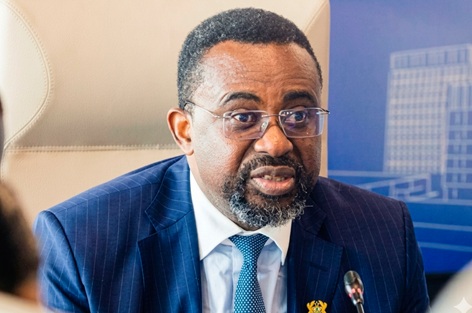
“Upside risks to the inflation outlook included the protracted Middle East crisis, which would keep crude oil prices above $100 per barrel and raise the prospect of petroleum price pass-through into domestic transport and utility costs,” the Governor of the Bank of Ghana, Dr Johnson Asiama, said at a post-Monetary Policy Committee (MPC) press conference in Accra.
Cedi under pressure
The bank’s caution comes as the cedi faces renewed pressure despite what appears to be one of the country’s strongest external positions in years.
According to the Bank of Ghana’s May 2026 Summary of Economic and Financial Data, the cedi traded at GH¢11.4125 to the dollar as of May 15, representing a year-to-date depreciation of 8.4 per cent from the GH¢10.45 recorded at the end of December 2025.
The reversal marks a sharp contrast to 2025, when the cedi staged one of its strongest recoveries in decades. By May last year, the local currency had appreciated by 43 per cent against the dollar before ending the year with a 40.7 per cent gain.
Pressure on the cedi has also spread across the major trading currencies. Against the British pound, the local currency weakened by 7.5 per cent to GH¢15.2055 by mid-May, while it also depreciated by 7.5 per cent against the euro to GH¢13.2695.
The renewed weakness suggests the currency’s earlier recovery is now facing a fresh sustainability test as demand for foreign exchange rises alongside imports, debt-service obligations and recovering private-sector activity.
Recovery faces test
The exchange-rate deterioration is occurring against the backdrop of improving macroeconomic fundamentals.
Inflation has fallen sharply to 3.4 per cent — comfortably below the lower bound of the central bank’s medium-term target band — while lending rates have eased and private-sector credit is beginning to recover.
Economic activity is also strengthening. The bank’s Composite Index of Economic Activity expanded by 12.6 per cent in March, compared with 2.3 per cent growth a year earlier, reinforcing expectations that the country may finally be entering the early stages of a genuine post-crisis recovery.
Finance and tax expert, Nelson Cudjoe Kuagbedzi, said the central bank’s decision to hold rates was widely expected, given mounting global uncertainty and the policy direction adopted by major central banks.
“It was actually expected that the Bank of Ghana would also maintain their policy rate, given the global trend that other central banks are doing,” he told the Graphic Business.
According to him, the central bank is attempting to balance inflation management with the need to keep credit accessible to businesses.
“On one hand, the Bank of Ghana wants to consider inflation; on the other hand, too, they want as much as possible to make capital accessible to the business community,” he said.
Mr Kuagbedzi noted that lending rates had declined considerably compared with previous years when borrowing costs exceeded 36 per cent.
“Lending rates have actually come down significantly,” he stressed.
MPC shifts focus
Yet, despite the stronger domestic backdrop, the MPC’s latest statement reveals a central bank increasingly uneasy about forces beyond its control.
The escalation of geopolitical tensions in the Middle East — particularly disruptions around the Strait of Hormuz — has significantly altered the global inflation outlook. Brent crude oil averaged $103.2 per barrel in April 2026, representing a 67.4 per cent increase since the beginning of the year.
Higher oil prices threaten to feed directly into transport costs, utility tariffs and imported inflation across emerging markets, including Ghana.
For the Bank of Ghana, this creates a familiar but uncomfortable dilemma.
Domestic demand conditions no longer justify an aggressively tight monetary stance. Credit growth is recovering, fiscal policy appears unusually disciplined, and confidence is gradually returning. Maintaining excessively restrictive policy for too long risks choking off investment just as the economy begins to recover.
But easing too early could destabilise the currency and reintroduce inflationary pressures through imported fuel, food and industrial inputs.
The challenge is complicated by the fact that the cedi’s weakness is occurring despite strong external buffers.
Total exports reached $11.15 billion by April 2026, significantly higher than imports of $5.87 billion, leaving a trade surplus of $5.28 billion, equivalent to 4.4 per cent of GDP.
Gold remains the anchor of the external sector. Gold exports stood at $6.86 billion by April, accounting for more than half of total export earnings, while cocoa exports reached $1.86 billion and oil exports totalled $1.28 billion.
Gross International Reserves remained robust at $13.95 billion in April, equivalent to 5.5 months of import cover. By May 18, total reserves had increased further to $14.42 billion.
Imports drive forex demand
Still, the currency’s depreciation despite these buffers points to deeper tensions within the foreign exchange market.
One major pressure point is the sharp rise in imports as economic activity recovers. Total imports climbed from $4.06 billion in March to $5.87 billion in April, driven partly by higher oil imports, which rose to $2.01 billion.
Non-oil imports also increased significantly to $3.86 billion, suggesting stronger domestic demand for machinery, industrial inputs and consumer goods.
This explains the MPC’s increasingly balanced tone.
Unlike earlier policy statements focused almost entirely on inflation suppression, the latest communiqué reflects a central bank shifting toward protecting macroeconomic stability from external shocks and exchange-rate volatility.
Recovery enters fragile phase
In many respects, the country is now better positioned than during previous commodity and currency crises. Fiscal performance has improved, banking-sector conditions have stabilised and economic activity is recovering faster than many analysts expected.
The rebound in growth is occurring from a low base after one of the country’s most severe macroeconomic crises in decades. More importantly, the central bank may soon confront the limits of disinflation driven largely by favourable base effects and earlier exchange-rate stability.
The challenge is no longer simply bringing inflation down. It is maintaining credibility, defending currency stability and sustaining growth in an increasingly volatile global environment.
For now, the central bank appears determined to avoid abrupt moves. The broader message from the MPC is clear: Ghana’s macroeconomic stabilisation remains intact, but the environment supporting it is becoming increasingly fragile.
After two years dominated by domestic crisis management, the greatest threat to the country’s recovery may once again come from beyond its borders.