
Law on false news ignites debate - Repeal or maintain?
The use of the criminal justice system to punish people who make derogatory, inciteful and hateful comments has reignited public debate about freedom of speech and the extent to which people should be held accountable for such comments.
Some advocates have condemned the arrest and prosecution of people over their public utterances, describing them as a violation of freedom of speech and a rebirth of the repealed criminal libel law.
However, others have welcomed such actions as lawful and necessary for sanitising public discourse, protecting others’ rights and enhancing the country’s security.
Varied views
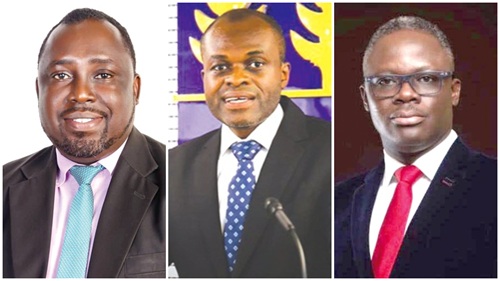
In an interview with the Daily Graphic, three lawyers – Martin Kpebu, Samson Lardy Anyenini and Albert Quashigah, who is also a law lecturer at the University of Professional Studies, Accra (UPSA), shared varied views.
While Mr Anyenini called for the complete repeal of the criminal provision on false publication- Section 208 of the Criminal Offences Act, 1960 (Act 29) due to its indiscriminate use and abuse to silence people, Mr Kpebu said the law should be replaced as its scope was too wide and was normally used to gag people and score political points.
Mr Quashigah, however, believes that the laws should be maintained to serve as a check on irresponsible and reckless speech that puts the country’s security and the lives of people at risk, adding, “free speech does not equate to irresponsible speech.”
What does the law say?
The laws which are normally invoked by the security agencies in arresting people who make such derogatory and inciteful statements are Sections 207 and 208 of the Criminal Offences Act, 1960 (Act 29), and Section 76 of the Electronic Communications Act, 2008 (Act 775).
Section 207 of Act 29 stipulates that: “a person who in a public place or at a public meeting uses threatening, abusive or insulting words or behaviour with intent to provoke a breach of the peace or by which a breach of the peace is likely to be occasioned, commits a misdemeanour.”
With regard to Section 208 of Act 29, it criminalises publication of false news and states that: “a person who publishes or reproduces a statement, rumour or report which is likely to cause fear and alarm to the public or to disturb the public peace knowing or having reason to believe that the statement, rumour or report is false commits a misdemeanour”.
It further adds that a person charged with the offence cannot rely on ignorance of the news being false as a defence unless there is proof that, prior to the publication, he took reasonable steps to verify the accuracy of the statement.
A person charged with Section 207 and 208 upon conviction is liable to a fine or a term of imprisonment of up to three years.
Section 76 of Act 775 criminalises publication of false news through an electronic communication service and stipulates that: “a person who by means of electronic communications service, knowingly sends a communication which is false or misleading and likely to prejudice the efficiency of life-saving service or to endanger the safety of any person, ship, aircraft, vessel or vehicle commits an offence and is liable on summary conviction to a fine of not more than three thousand penalty units or to a term of imprisonment of not more than five years or both.”
Context
Despite the repeal of the Criminal Libel Law in 2001, the use of Sections 207 and 208 of Act 29 to arrest and prosecute social commentators, politicians and sympathisers of political parties over their utterances in public has been a regular feature under successive governments.
Ironically, the two major political parties — the governing National Democratic Congress (NDC) and the opposition New Patriotic Party (NPP) — condemn such actions when they are in opposition, but find nothing wrong and actually applaud them when they are in government.
In 2022, during the reign of President Nana Addo Danquah Akufo-Addo, the current President, John Dramani Mahama, then the opposition leader, following a spate of arrests of journalists, social commentators and activists, wrote an open letter condemning such actions, describing it as dangerous to the country’s democracy.
Recently, in May this year, the flag-bearer of the NPP and former Vice-President until January 7, 2025, Dr Mahamudu Bawumia, also condemned the arrest and what he described as harassment of NPP members and social commentators affiliated to the party.
Repeal
Mr Anyenini, who is also an award-winning journalist, told the Daily Graphic that Sections 207 and 208 of Act 29 should not be part of the criminal code of the country as they were often used indiscriminately to abuse people’s freedom of speech.
“Police and prosecutors continue to invoke Section 208 indiscriminately against critical voices.
The provision has become a convenient weapon to silence dissent, leading to arbitrary arrests, prolonged detention and prosecutions that stifle legitimate speech,” he said.
He further called for the amendment of Section 76 of Act 775 to limit the sanction to fines only, with the removal of prison terms.
Mr Kpebu said Section 208 of Act 29 was bad law as its remits were too wide.
“It should be repealed because it is too broad and it is used to punish all manner of accusations, including comments that appear to be political satire.
We must be specific on what constitutes false news and to me false information that can put people or the nation in danger, that ought to be punished,” he added.
Maintain the laws
Mr Quashigah said the laws should be maintained as freedom of speech and other rights were without restrictions, adding that “no country operates unfettered human rights.”
“Freedom of speech is not equivalent to irresponsible speech.
While we must respect human rights, other considerations such as public morality, safety and national security, irresponsible public speech which results in a crime must not go unchecked even if it has to go through the criminal process,” he added.
