
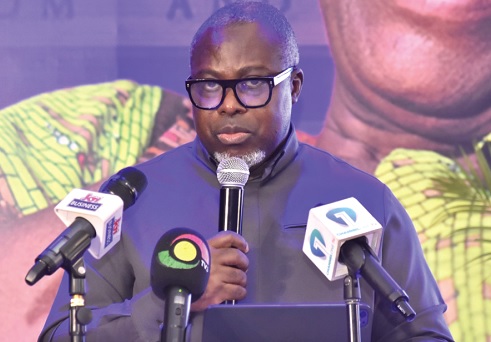
2026 Budget: VAT reforms to boost business growth — GRA Boss
The sweeping Value Added Tax (VAT) reforms contained in the 2026 Budget are designed to create a stronger business environment, reduce operational costs and stimulate job creation across key sectors, the acting Commissioner-General of the Ghana Revenue Authority (GRA), Anthony Sarpong, has clarified.
He explained that raising the VAT registration threshold from GH¢200,000 to GH¢750,000 would remove the tax compliance burden from thousands of micro and small businesses, allowing them to focus on expansion and employment.
"Eliminating the cascading effect of VAT, scrapping the one per cent COVID levy and making the National Health Insurance Levy (NHIL) and the Ghana Education Trust Fund (GETFund) levies fully claimable as input credits will significantly reduce production costs," Mr Sarpong said at a Post 2026 Budget Forum in Accra yesterday.
2026 Post-budget forum
On the theme, "Resetting for growth, jobs and economic transformation", the forum created a platform for players in the private sector and other stakeholders to share opinions on the 2026 budget.
The event was attended by former Chief Secretary to the United Kingdom Treasury, Lord Paul Boateng; the Chief Executive Officer of the Ghana Chamber of Mines, Kenneth Ashigbey; Director of the Real Sector at the Ministry of Finance, Samuel Danquah Arkhurst; the Managing Director of Graphic Communications Group Ltd, Ato Afful; the Country Managing Partner, KPMG, Andrew Akoto; and the Resident Representative of United Nations Development Programme (UNDP), Niloy Banerjee.
KPMG and UNDP, who carried out a stakeholder survey before the presentation of the 2026 Budget, organised the forum.
Business expansion
Mr Sarpong, the former Country Managing Partner of KPMG, who was the guest speaker, stated that the changes would cut the effective VAT rate from 21.9 per cent to 20 per cent, leaving more income in the hands of consumers and businesses while driving higher consumption and business growth.
He stressed that abolishing VAT on mineral exploration was expected to attract investment into the extractive sector and open new opportunities for job creation.
The GRA Commissioner-General said the VAT reforms were the backbone of a broader government strategy to use tax policy as a catalyst for business expansion, revenue mobilisation and nationwide economic transformation.
Forward-looking blueprint
The Commissioner-General stressed that the combined effect of these reforms was a more predictable, transparent and investment-ready business environment.
“Lower upfront costs for investors, faster customs clearance and improved integrity at the ports will not only make Ghana more attractive for foreign and domestic investment, but also support manufacturers, importers and exporters to operate efficiently,” he said.
Mr Sarpong added that the measures positioned the 2026 Budget as a forward-looking blueprint designed to boost trade, enhance revenue mobilisation, and drive long-term economic growth.
Ghana’s transition
Mr Arkhurst said Ghana’s transition, nearly four decades ago, from simple administrative budget statements to full policy-based documents marked a decisive shift towards prioritising real-sector performance as the true measure of economic progress.
He explained that over time, policymakers recognised that Gross Domestic Product (GDP) growth — not just fiscal balances — provided the clearest signal of productivity, value creation, and the overall strength of the real economy.
He said the evolution, now anchored in Article 179 of the Constitution and Section 31 of the Public Financial Management Act, 2016 (PFM Act 921), aligned with the 2026 budget theme: “Resetting Growth, Jobs and Economic Transformation.”
Mr Arkhurst added that real-sector indicators such as output, employment and industrial expansion remained the most credible reflections of whether GDP growth was being translated into tangible improvements in the lives of Ghanaians.
Youth unemployment
For his part, Mr Banerjee stressed that Ghana’s high youth unemployment presented an opportunity to reimagine economic growth by strengthening entrepreneurship and positioning small and medium enterprises (SMEs) as a central engine for job creation.
The Resident Representative of UNDP said reducing the high cost of doing business, including the steep 17 per cent loan rates facing SMEs, was critical to unlocking private sector investment and enabling a new wave of innovative start-ups to thrive with government-backed risk-sharing support.
Annual pre-budget survey
Mr Akoto explained that KPMG’s annual pre-budget survey played a key role in gathering the views of businesses across sectors, helping to ensure that the government’s fiscal planning reflected the real challenges and expectations of industry.
He added that the integration of many of those priority areas into the 2026 Budget demonstrated the usefulness of KPMG’s evidence-based recommendations in guiding policies that supported Ghana’s business environment and long-term growth.
