
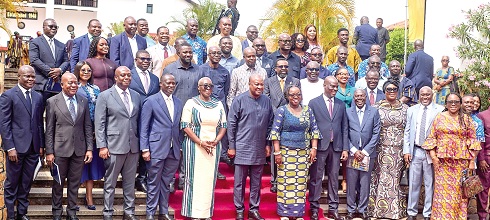
At New Year School: President outlines 5-pillar vision - Announces major reforms, final IMF exit
A collective national endeavour, disciplined implementation and an irreversible break from the cycle of economic bailouts are imperatives to build the sustainable Ghana its citizens desire, President John Dramani Mahama has stated.
Addressing the opening of the 77th Annual New Year School and Conference (ANYSC) at the University of Ghana, the President said the nation was at a defining crossroads and urged a united transition from short-term fixes to long-term development anchored on robust institutions, value addition and accountable governance.
“We cannot build the Ghana we want if the progress made under one regime is reversed under another. Economic development programmes must be medium to long term.
We cannot build the Ghana we want together if after every regime change, economic development programmes are discarded and replaced with entirely new ones,” President Mahama who campaigned on slogan “Building the Ghana We Want” said.
The ANYSC, organised by the School of Continuing and Distance Education under the theme “Building the Ghana We Want Together for Sustainable Development,” served as a platform for the President to unveil a comprehensive roadmap intended to transcend political seasons and cement lasting progress.
Central to this vision is a decisive exit from International Monetary Fund (IMF) support.
President Mahama announced that Ghana was on course to conclude its Extended Credit Facility by the middle of this year, stating emphatically that this must be “the 17th and the last time” the nation seeks such a bailout.
The President cited a strengthened economic foundation, including a stable currency hailed as 2025’s best-performing globally, reduced inflation, a lower debt-to-GDP ratio, and bolstered foreign reserves as grounds for confidence.
Reforms
To lock in these gains and ensure they survive future political transitions, President Mahama announced major governance reforms.
Key among them is the Constitutional Review Implementation Committee, which would be inaugurated before the end of this month, of a to advance recommendations for national governance restructuring.
Furthermore, he said, an Independent Value for Money Office would be established this year to scrutinise all public expenditure.
There would also the Code of Public Officers Bill to be passed to legally enforce accountability, the President added.
Value addition
On the economic front, President Mahama announced a policy shift mandating value addition to all minerals, petroleum and agricultural products before export.
That, he said, was core to the transformative 24-Hour economy strategy, designed to deepen manufacturing, create jobs and build resilience.
The nation’s infrastructure is also set for a historic boost under a “Big Push” programme, with GH¢30.8 billion allocated for 2026. This will fund nationwide projects in roads, rail, health and education, President Mahama pointed out.
Two landmark projects of the Big Push initiative are the construction of the Accra-Kumasi Expressway to connect the two major cities, and a new smart Green Digital City across three regions to decongest the capital.
The President’s vision rests on five foundational pillars: a productive, diversified economy; human capital development; good governance and national scipldiine; environmental stewardship and climate resilience; and inclusion, cohesion, and shared national purpose.
Gender balance
He pledged to enforce the Affirmative Action Law, ensuring greater female representation on public boards, and commended ongoing efforts to combat illegal mining, noting visible improvements in some river bodies.
President Mahama charged all societal pillars — academia, private sector, civil society, traditional authorities, and the media — to play their part in the collective national project.
“The Ghana we want is not an illusion. It is achievable through discipline, hard work, unity and visionary leadership,” he stated, before declaring the conference duly open.
Deliberate dialogue
The Vice-Chancellor of UG, Professor Nana Aba Appiah Amfo, in his welcome address, underscored the historic role of the New Year School as a "unique platform where the gown meets the town," bringing together stakeholders from all sectors for deliberate dialogue critical for national development.
She stated that the theme, "Building the Ghana We Want, Together for Sustainable Development," was intentionally collaborative, reminding the nation that the desired future "cannot be crafted by one institution, one sector of government, or one organisation alone."
Highlighting the University of Ghana's concrete contributions, the Vice-Chancellor detailed initiatives such as the recently commissioned innovation enclave and maker space, developed with Imperial College London, designed to transform ideas into solutions for Africa's challenges.
Prof. Amfo also reported significant progress on the Digital Youth Village, a flagship project to build digital entrepreneurship skills for youth nationwide, stating that it was over 60 per cent complete and slated to be the hub for the government's One Million Coders programme.
The Vice-Chancellor expressed gratitude for governmental support for the university’s projects, but also pointedly appealed for the timely release of allocated funds to contractors, addressing the President and the financial officials present directly.
She stated that the university’s interventions were "not vanity metrics" but active participation in building a sustainable future, aligning its strategic priorities with the national goals outlined in the President's New Year message.
Furthermore, Prof. Amfo outlined a special feature of this year's conference: a project forum to showcase youth-led innovations from Ghana and abroad, including tech projects from the Bahamas and Estonia, and local initiatives in agriculture and digital coding.
That, she said, embodied the conference's goal of accelerating active collaboration between the government, academia, the private sector and citizens to propel the nation forward.
National course
In her opening remarks, the Chair of the University Council, Marietta Agyeiwaa Brew, described the conference as a critical national forum, drawing the "finest minds" from across society to deliberate on the nation's course.
She urged attendees to deeply interrogate the core principles embedded in the theme, namely want, together and sustainable.
Elaborating on the principles, Ms Brew, who is also the Legal Advisor to the President, stated that "The Ghana we want" acknowledged a gap between the present nation and its potential, emphasising that the vision must extend beyond mere economic stability to encompass social justice, dignity and the absolute rule of law.
On the necessity of collective action, she asserted that nation-building "is not a solitary pursuit" but a shared responsibility requiring the disciplined effort of every Ghanaian, noting that "one finger is not enough to lift a load."
Furthermore, she defined the desired "sustainable" development as progress that is "not periodic or reversible," but resilient enough to transcend political cycles and endure changing global conditions.
True sustainability, she argued, lies in building robust systems, institutions, and values that deliver results long after their architects have departed.
Concluding her thematic guidance, Ms Brew characterised the conference as an "active construction site" where participants must act as architects, masons, and surveyors to build ideas that stand the test of time.
Others speakers
Other speakers included business executive and Board Chairman of MTN Ghana, Ishmael Yamson, who delivered the keynote address; the Governor of the Bank of Ghana, Dr Johnson Asiama, the Chief Executive Officer (CEO) of the National Petroleum Authority, Godwin Edudzi Kudzo Tameklo; the CEO of the Petroleum Hub Corporation, Dr Toni Aubynn, and the President of the ECOWAS Bank for Investment and Development, Dr George Donkor.
Others are the CEO Ghana Chamber of Mines, Ken Ashigbey; the Deputy Secretary General of the Trades Union Congress, Dr Kwabena Otoo; Deputy CEO, Food and Drugs Authority, Gayheart Edem Mensah, among others.
Before the ANYSC issues a communique today, the conference will host the Minister of Finance, Dr Cassiel Ato Forson, who would apprise the conference participants on the economic strategy of the government going forward.
