
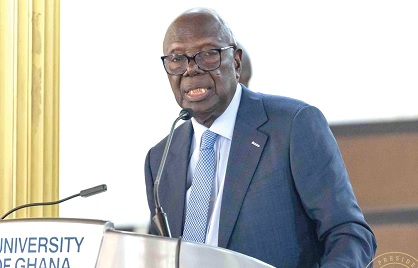
A renowned business executive, Ishmael Yamson, has outlined a five-pillar reform agenda which he says are essential to move the country from macroeconomic stabilisation to lasting socioeconomic transformation.
He explained that even though the current government had made commendable progress in restoring stability over the past year, citing declining inflation, improved currency performance and renewed fiscal discipline, stabilisation should not be mistaken for transformation.
“We are at a definitive crossroads of our national existence. We have stopped the bleeding, yes. But we have not healed the wound.
We have managed the crisis, but we have not cured the disease. To truly build the Ghana we want, we do not need a policy tweak.
We do not need the same mindset, behaviours and values that brought us to where we are today,” he stressed.
Mr Yamson said this during a keynote address at the opening of the 77th University of Ghana (UG) Annual New Year School and Conference (ANYSC) in Accra yesterday.
Event
It was organised by the School of Continuing and Distance Education (SCDE) under the College of Education on the theme: “Building the Ghana We Want Together for Sustainable Development”.
It brought together government representatives, private sector players, academia and industry leaders, among others, for a critical reflection on national issues, evidence-based policy dialogue and the generation of practical solutions to support inclusive and sustainable growth.
Leadership
Mr Yamson, who is the Board Chair of MTN Ghana, said the first pillar was a refocus of leadership purpose and culture, shifting from entitlement to service, and enforcing accountability through a strong code of conduct for public office holders, describing right leadership as “non-negotiable”.
“Throughout my career, I've come to the reality that businesses and countries succeed and thrive depending on their own leadership. Almost always led by one individual with a clear purpose to build. Whether you talk about Malaysia or Singapore or Dubai or Rwanda, Vietnam or South Korea or other such successful countries, the story is the same,” he said.
He said the second pillar centred on governance reform and the fight against corruption, and advocated aggressive digitisation of high-discretion public services such as ports, land administration and procurement to eliminate opportunities for bribery and abuse.
On the third pillar, the statesman called for sustained fiscal and monetary discipline, including the enforcement of a statutory debt ceiling, the establishment of an independent fiscal council with binding powers, and policies to reduce the cost of capital to support industrial growth.
Economic structure
The fourth pillar focused on structural economic transformation and building a future-fit economy.
Mr Yamson urged the country to move beyond exporting raw materials to processing what it produced, while aligning education with industry needs, and prioritising technical and vocational skills relevant to emerging sectors such as artificial intelligence, clean energy and robotics.
The fifth pillar, he said, required redefining the role of the state by withdrawing from commercial activities better handled by the private sector and instead de-risking investment, providing infrastructure and creating a predictable policy environment.
Mr Yamson warned that complacency and election-year fiscal excesses could derail the reset agenda, stressing that the five pillars must be pursued together to secure sustainable growth and restore national confidence.
“To reset, Ghana will require decisive simultaneous action on five strategic fronts.
This is not a menu from which we can pick and choose. This is an integrated architecture for survival,” he stressed.
The Governor of the Bank of Ghana (BoG), Dr Johnson Pandit Asiama, stressed that macroeconomic stability was an enabler, not an end of sustainable development, underscoring the need for collective action beyond government.
He enumerated the Ghana Gold Board (GoldBod) and domestic gold purchase programme as strategic tools to strengthen reserves, stabilise the currency and anchor long-term economic resilience.
“If the past year, 2025, was about restoring confidence in the economy, then the year ahead, 2026, must be about putting that confidence to work, carefully, productively and with judgment, in service of a more resilient, inclusive, and competitive Ghanaian economy,” he said.
The President of the ECOWAS Bank for Investment and Development (EBID), Dr George Agyekum Donkor, framed the nation’s development challenges within broader ECOWAS vulnerabilities, advocating strong institutions, meritocracy, infrastructure investment and skills-driven education.
He pledged EBID’s support for sustainable development, emphasising entrepreneurship, regional integration and climate-conscious growth as building blocks for what the citizens could proudly call home.
The Chief Executive Officer (CEO) of the National Petroleum Authority (NPA), Godwin Kudzo Tameklo, said the downstream petroleum sector must support government’s reset agenda through affordability, quality and reliability of fuel supply.
He outlined the NPA’s role in fair pricing, regulation and coordination of the 24-hour economy, aimed at job creation, energy security and sustainable industrial activity.
The CEO of the Petroleum Hub Development Corporation (PDHC), Dr Toni Aubynn, argued that growth without structural transformation was insufficient, and called for value addition and industrialisation to secure lasting recovery.
He presented the Petroleum Hub as a catalyst for diversification, employment and resilience, stressing its potential to boost GDP significantly while ending Ghana’s dependence on raw commodity exports
