
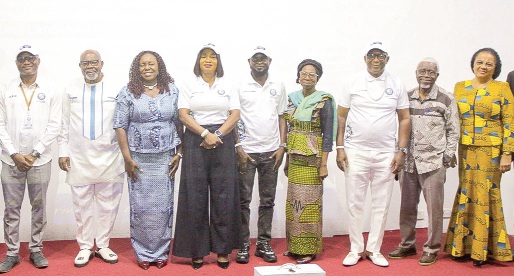
An initiative aimed at repositioning the country’s fisheries sector as a major driver of investment and national prosperity was launched in Accra yesterday.
Dubbed; “Ghana Blue Economy and Fisheries Transformation Initiatives Ghana (BEFTIG)”, it will strengthen the nation as Africa’s leading blue economy hub by promoting sustainable fisheries, attracting investment and improving livelihoods in coastal communities.
The initiative will also address challenges such as illegal fishing, dwindling fish stocks, limited financing and inadequate infrastructure through policy reforms, innovation, environmental stewardship and strategic partnerships.
It will encourage sustainable fishing practices, modern resource management and investments in aquaculture, fish processing and export infrastructure to create jobs.
As part of its rollout, BEFTIG plans to distribute first aid kits to 1,000 canoes before expanding the programme to other coastal regions nationwide, under its “One Canoe, One First Aid Kit” initiative to improve safety at sea.
The initiative, launched on the theme, “Re-imagining Ghana’s Blue Economy; Driving Sustainable Fisheries, Investment and National Prosperity,” brought together fisherfolk and related groups, senior government officials, industry leaders, among others.
Movement for transformation
Speaking at the launch, the Executive Founder and Private Sector Lead of BEFTIG, Ebenezer Otoo, said the initiative was a movement to transform the country’s blue economy by harnessing the country’s marine and inland water resources.
He outlined plans to establish marine industrial parks near fishing harbours where locally manufactured boats and canoes would be produced at affordable prices to reduce the financial burden on fisherfolk while creating employment.
He said BEFTIG was also partnering financial institutions to improve access to credit for fishmongers and entrepreneurs along the fisheries value chain, which he said had the potential to create about one million jobs.
Mr Otoo announced a 90-day action plan following the launch, alongside engagements with the United Nations on Sustainable Development Goals, scholarship schemes for children of fisherfolk, healthcare support through harbour clinics.
The Deputy Minister of Local Government, Chieftaincy and Religious Affairs and Member of Parliament (MP) for La Dadekotopon, Rita Naa Odoley Sowah, said Metropolitan, Municipal and District Assemblies (MMDAs) would remain central to developing fisheries and aquaculture through investments in infrastructure, market access and local economic development.
She emphasised that empowering women involved in fish processing and marketing through finance, technology and entrepreneurship training was an economic necessity, while investments in youth employment would stimulate innovation and improve livelihoods.
Modernise sector, partnerships
The Paramount Chief of Osu, Notse Nii Prof. Nortey Owuo IV, urged stakeholders to rethink the country’s relationship with the sea by embracing modern approaches to fisheries development.
He challenged universities to establish specialised fisheries programmes and encouraged policymakers and financial institutions to develop tailored financing models for the sector.
The Queenmother of Asere-Amartse We of the Ga State and Head of Women Banking at Stanbic Bank Ghana, Naa-Amorkor Shika Futru I, stressed that partnerships among government, financial institutions, academia, development partners and local communities would be critical to building resilient fisheries value chains and improving access to finance and markets.
She particularly advocated placing women and young people at the centre of the transformation agenda through greater financial inclusion, skills development and enterprise support to maximise the sector’s social and economic impact.
The President of the National Fisheries Association of Ghana (NAFAG), Nana Jojo Solomon, expressed concern that the country’s fishing industry was gradually losing space to competing sectors, particularly oil and gas, while receiving inadequate government attention despite employing about 10 per cent of the country’s population and providing roughly 60 per cent of its animal protein needs.
While acknowledging the importance of oil and gas, he argued that fisheries remained a renewable resource capable of sustaining generations if properly managed.
