
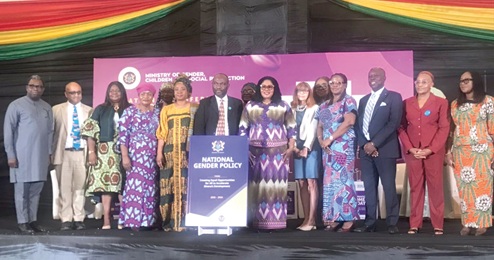
Commemoration of International Women’s Day: National gender policy launched
The Ministry of Gender, Children and Social Protection has launched a national gender policy, a framework to create equal opportunities for all by improving social, legal, civil, political, economic and cultural conditions in the country.
The policy, which spans 2025-2034, replaces that of 2015, which expired in 2020. It aligns with the National Development Planning Commission’s guidelines for policy formulation.
The launch of the policy in Accra yesterday was on the theme: “Creating equal opportunities for all to accelerate Ghana’s development”.
Its implementation would be coordinated by the sector ministry, with active involvement of all three arms of government, development partners, civil society organisations, traditional authorities and the private sector.
The policy was reviewed last year after extensive stakeholder consultations and validation workshops across the country.
It is anchored on six core objectives — promoting gender equality and women’s empowerment through safe livelihoods, decent work and economic opportunities; enforcing international treaties and domestic policies that combat violence and discrimination; ensuring access to justice and advancing rights-based approaches; and increasing women’s participation in politics, among others.
The event coincided with the commemoration of International Women’s Day, which was on the theme: “Rights. Justice. Action. For all women and girls.”
Mainstreaming
The sector minister, Dr Agnes Naa Momo Lartey, said the policy would strengthen gender mainstreaming through improved institutional coordination, accountability mechanisms, data systems and targeted support for vulnerable women and girls.
“To our colleague ministries, gender mainstreaming must reflect in your sector policies, budgets and performance indicators,” she said.
The minister said her outfit would coordinate with development partners to secure technical and financial support to implement the policy and related programmes.
Roadmap
A consultant to the policy draft, Sheila Minkah-Premo, described the document as a comprehensive and forward-looking roadmap designed to accelerate gender equality and women’s empowerment across all sectors of national life.
The legal practitioner and gender advocate commended the ministry for steering what she termed a rigorous and participatory process to produce a framework aligned with the national development agenda.
She said the document was firmly anchored on Ghana’s 1992 Constitution, national development frameworks and international commitments on gender equality, adding that “this is a document that shows the direction Ghana wants to go”.
Ms Minka-Premo said a key feature of the policy was its detailed monitoring and evaluation framework.
Coherence
The UN Resident Coordinator, Zia Choudhury, said the new policy was more coherent, clarified responsibility and ensured sustained direction across government and society.
He added that accountability must be specific and measurable, rather than general, adding, “This is an all-of-Ghana effort.”
Mr Choudhury stressed the need to strengthen protection systems, ensure access to justice and address harmful practices, including accusations of witchcraft against vulnerable women.
The Chairperson of the Women’s Caucus in Parliament, Comfort Doyoe Cudjoe, in a speech read on her behalf, described the policy as both timely and strategic.
She, however, cautioned that the policy document alone would not transform lives, but would require effective implementation, consistent monitoring, adequate financing and collective ownership.
For her part, the Chairperson of the Parliamentary Standing Committee on Gender, Children and Social Welfare, Helen Adjoa Ntoso, also said that achieving the objectives of the policy would require strong political will, institutional coordination, active civil society engagement, private sector partnership, and transformation of social norms at the community level.
