
ECOWAS sets up Standby Force to combat terrorism
The Economic Community of West African States (ECOWAS) is taking decisive action to combat terrorism in the region with the activation of its Standby Force.
Already, a commitment of 1,650 military personnel have been made by the ECOWAS member states and the Sahel States, with the force expected to scale it up to 5,000 troops to tackle the growing threat of terrorism in the region.
The acting Head of ECOWAS Peace Support Operations Division (PSOD), Dr Sani Adamu, said ECOWAS had directed the activation of the Standby Force in its kinetic form to combat terrorism.
To facilitate this, he said, Ministers of Finance and Defence from the region recently met in Abuja to discuss resource mobilisation.
Tripartite Meeting
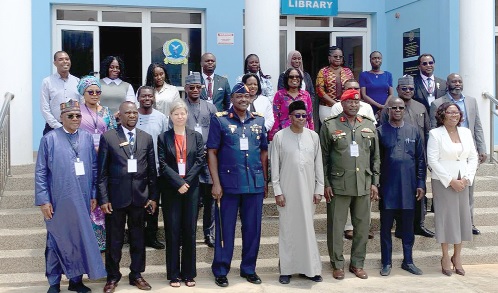
Dr Adamu was speaking at the opening of a three-day Tripartite Meeting of Commandants of ECOWAS Training Centres of Excellence in Peace Support Operations taking place in Accra.
It is being organised by ECOWAS, in collaboration with the Kofi Annan International Peacekeeping Training Centre (KAIPTC), on the theme: “Strengthening Regional Efforts at Curbing Emerging Security Threats”.
Over 20 Commandants from all countries in the ECOWAS sub-region are attending.
Capacity building and training
To ensure the effectiveness of the Standby Force, the acting Head of the ECOWAS PSOD said ECOWAS had established three training centres of excellence.
“The Abuja Centre provides strategic-level training, while the KAIPTC offers operational-level training, and the Peace Centre in Mali delivers tactical-level training. These centres will play a crucial role in equipping troops with the necessary skills to respond to terrorist threats,” he said.
He added that the ECOWAS Standby Force had already been deployed in Guinea-Bissau and The Gambia, where it was providing critical support to maintain peace and stability.
Dr Adamu indicated that the establishment of the Standby Force demonstrated the region's commitment to collective security and cooperation. By pooling their resources and expertise, he said, the region could better address the complex security challenges facing it.
Intervention
ECOWAS Commissioner for Political Affairs, Peace and Security, Abdel-Fatau Musah, said the activation of the ECOWAS Standby Force was timely, as the region continued to grapple with transnational organised crime, climate-related violence, intercommunal clashes, and farmer–herder conflicts.
He added that with more than 60 per cent of the population under the age of 25, the region must integrate its youth into the regional integration project to prevent them from becoming a security threat.
He also said that although terrorism was predominant in the Sahel, it was not limited to it, as it was also spreading to the coastal countries.
Call for action
For his part, the Deputy Commandant of KAIPTC, Brigadier General Ziblim Ayorrogo, said terrorism was a threat that cut across the entire sub-region, requiring a holistic response.
He emphasised that countries in the region could not afford to think that terrorism only affected specific countries, adding that training and resources were essential in motivating troops to fight terrorism.
"If we go to sleep, we're going to have a crisis.
When troops are trained and well-resourced, that is the first element of motivation.
A well-equipped and trained Standby Force would be better positioned to contain the threat of terrorism, rather than relying on vigilante groups in certain parts of West Africa in fighting off terrorist groups,” he added.
