
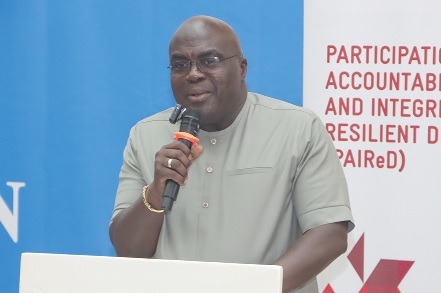
Govt will fight corruption to boost investor confidence — Julius Debrah
The Chief of Staff, Julius Debrah, has reaffirmed the government’s determination to confront corruption head-on as a prerequisite for achieving President John Dramani Mahama’s 24-hour economy agenda and restoring investor confidence.
That, he said, was because corruption was the greatest threat to the country’s economic transformation.
“Government resources are limited. But we must recognise that corruption prevention is not a competing priority.
If we fail to protect our resources, we will never have enough to build the schools, hospitals and roads our people deserve. We will never create decent jobs for our youth.
We will never realise the 24-hour economy as we envision,” he stated.
He was speaking at the launch of the Regional Stakeholder Engagements for the formulation of a National Ethics and Anti-Corruption Strategy and Implementation Plan (NACAP) 2026–2030 in Accra yesterday.
Overview
The country’s 2015–2024 NACAP built awareness, fostered cross-sector collaboration, and established the Office of Special Prosecutor.
It, however, suffered limited impact due to stagnant corruption scores, funding gaps, and weak local outreach. A new five-year strategy, therefore, is being drafted through nationwide consultations to create a practical, citizen-owned, and enforceable anti-corruption framework.
Cost, ethics, action plan
The Chief of Staff referenced data from the Ghana Anti-Corruption Coalition, which estimates that Ghana loses about US$3 billion to corruption each year—double the country’s annual foreign direct investment inflows of roughly US$1.5 billion.
“This staggering loss deprives us of funds for development. Similarly, corruption also erodes investor confidence, clogs our institutions with inefficiency and undermines the very trust that holds our democracy together.
“Corruption is a silent force that stalls progress, drains public resources and drives our youth to seek opportunities abroad, even in countries that once looked up to Ghana as a leader. We must confront this reality,” he lamented.
Mr Debrah further warned that unethical practices were seeping beyond public institutions into homes and schools, citing the recent ExxonMobil revelations as a wake-up call.
“That is why ethics must be central to a new plan, not just as a policy, but as a national culture,” he said, calling for collective action, accountability, transparency and integrity into the fabric of society.
He stressed that the new action plan would be anchored in the Office of the President to ensure strong oversight and prioritisation, learning from the underfunding challenges of the 2015–2024 strategy.
“Funding ethics and anti-corruption is not a cost; it is an investment,” he stated, adding that safeguarding public resources was fundamental to building a resilient economy.
Mr Debrah urged stakeholders to be “candid, practical and bold”, noting that disagreements during consultations should be embraced to produce a “refined and implementable plan” that reflected the aspirations of the masses.
Declining score
The Head of the Ghana Integrity Initiative (GII) and a representative of the plan’s Working Group, Mary Awelana Addah, stressed the country’s declining Transparency International Scores (43 in 2020–23, 42 in 2024) as evidence of persistent corruption.
She, therefore, described the 2026–2030 NACAP as crucial, emphasising measurable indicators, ethics-driven reforms, and shared responsibility beyond government to rebuild trust, boost investor confidence, and ensure sustainable anti-corruption fight.
“To ensure this happens, from next year, we are engaging over 400 multi-stakeholder institutions nationwide,” she stated, calling for collective citizen–government partnership beyond slogans to rebuild ethics, close enforcement gaps, in order to restore trust.
