
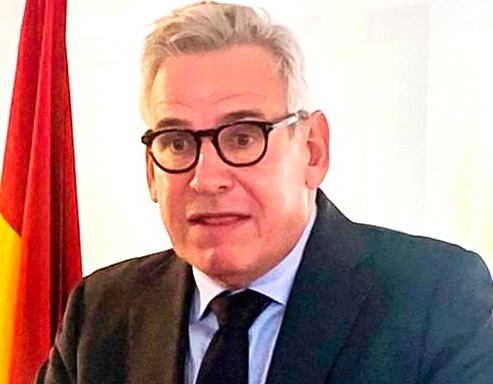
EU commemorates 50 years in Ghana: Ghana is a preferred partner — Ambassador
The European Union Ambassador to Ghana, Rune Skinnebach, has reaffirmed the bloc’s commitment to deepening ties with Ghana, describing the country as a preferred partner as the union commemorates 50 years of diplomatic and development cooperation.
He said the EU-Ghana relationship had evolved significantly over the past five decades—from a traditional donor-beneficiary arrangement, into a more equal and strategic partnership.
“A partnership that is coming from a donor-beneficiary one into a much more mature, much more equal, much more political partnership. And we want to be the preferred partner of Ghana. Ghana is certainly the preferred partner,” the ambassador said.
Mr Skinnebach was speaking at a media launch of Europe Month celebrations in Accra last Monday.
The anniversary will be marked with a series of activities, including a seven-day bicycle ride from Tamale to Accra, which was undertaken by EU ambassadors and some cycling teams; a major reception, sporting events, and public engagements aimed at increasing awareness of the EU’s presence and role in Ghana.
Mr Skinnebach acknowledged that many Ghanaians had limited knowledge of the EU and its activities despite being the country’s largest development and security partner, biggest investor, and leading export market.
“We are aware of the paradox here.
We have been here for 50 years, and yet there are too many Ghanaians who don't know what the EU is; they wonder whether it is an NGO, a UN body, or like the World Bank,” he said.
Mr Skinnebach, therefore, said that Europe Month activities were designed to bridge the gap and strengthen public engagement.
“We may not be the fastest or most agile partner, but we are the most reliable. We may not be the most agile, the fastest of partners and offers out there, but we are the most reliable,” he said.
Mr Skinnebach further said that his outfit did not stop development cooperation or introduce tariffs.
Security
On security, Mr Skinnebach expressed concern about instability in the Sahel region, particularly developments in Mali, and the potential risk of spillover into the country.
He said the EU was working closely with Ghana under a newly signed security and defence partnership framework to address emerging threats.
Mr Skinnebach further disclosed that about 60 per cent of EU development programmes in the country were concentrated in the northern regions, where they were tackling socio-economic vulnerabilities that could fuel instability, especially among the youth.
Touching on economic cooperation, the ambassador said the EU remained the country’s most balanced trading partner, with near parity between imports and exports, unlike trade relations with some other countries.
He also said more funds had been committed to the country under an EU Global Gateway initiative, which seeks to boost infrastructure, connectivity and sustainable development across Africa.
Mr Skinnebach, however, urged the government to improve its business environment by tackling corruption, enhancing port efficiency and investing in infrastructure to attract more European investment.
On Ghana’s economy, Mr Skinnebach described the current performance as encouraging but cautioned that it remained vulnerable due to reliance on gold prices and ongoing fiscal adjustments.
