
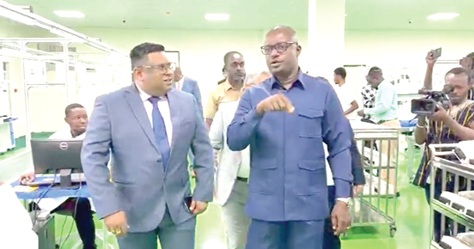
The Minister of Energy and Green Transition, John Abdulai Jinapor, has announced measures to address the persistent challenges in electricity metering, including shortages, delays in access and complaints of abnormal billing.
Mr Jinapor said he had directly engaged the Electricity Company of Ghana (ECG) and the Northern Electricity Distribution Company (NEDCo) to urgently resolve the supply constraints and streamline distribution processes.
He assured the public that the persistent meter shortages would soon a thing of the past, especially with the establishment of a local manufacturing plant to reduce reliance on imports.
The minister acknowledged the widespread public frustration over the difficulty in obtaining meters and the long waiting periods consumers faced before installation.
Seven-day deadline
In a speech delivered on his behalf by the Deputy Minister, Richard Gyan-Mensah, at the commissioning of the MBH Power Meter Manufacturing Facility in Tema yesterday, the minister described accurate metering as fundamental to fairness, transparency and revenue protection in the country’s power sector.
Mr Jinapor, who spoke briefly at the event before departing for another assignment, said the institutions had been given a seven-day deadline to submit a report and propose lasting solutions to address the irregular meter readings in order to restore consumer confidence.
On concerns about high and inaccurate billings, the minister said he had instructed ECG and the Energy Commission to investigate complaints of under-billing and over-billing.
He emphasised that while the nation currently faced no power generation deficit, challenges within the distribution network were being actively resolved.
The government, he said, remained committed to improving service delivery, ensuring accurate billing and strengthening Ghana’s electricity value chain through strategic partnerships and local production initiatives.
The minister described the commissioning of the MBH Power Meter Manufacturing Facility as a major milestone in the country’s energy sector, marking a significant shift towards local production and industrial growth.
He emphasised that accurate and reliable metering was central to efficiency, transparency and revenue assurance across the electricity value chain, namely from generation to distribution and final consumption.
Proper metering, Mr Jinapor said, would ensure fair billing, reduce losses and strengthen financial sustainability within the power sector.
Mr Jinapor added that for years, the nation had relied heavily on imported meters, leading to capital outflows and limited local participation in the industry.
However, the establishment of MBH Power’s manufacturing plant now signalled a strategic move to reduce import dependence, retain economic value locally, create skilled and semi-skilled jobs and build technical capacity within the country.
"While imports have helped us expand access, they have also meant capital outflow and limited local participation in this critical segment of energy industry.
Today, we are proud that this narrative is changing. With the establishment of MBH Limited Manufacturing Plants here in Ghana, we have taken a bold step towards local production," he said.
"We are, therefore, happy to partner with credible private investors like MDH Power who share our commitment to reliability, innovation and national development.
Our energy sector reform agenda emphasises improved metering, reduction of commercial and technical losses, enhanced revenue mobilisation and manufacturing to align perfectly with these priorities," he stressed.
He reaffirmed the government’s commitment to fostering partnerships with credible private investors to drive innovation, improve metering systems, reduce commercial, technical losses and enhance revenue mobilisation.
He further assured stakeholders that it would continue to promote policies that encouraged local content, industrialisation and sustainable investment, describing the project as a strategic partnership for national progress and long-term energy sector resilience.
750,000 units annually
The Director of the Ghana Office of MBH Power Limited, Nikel Goel, reaffirmed the company’s long-term commitment to Ghana’s power sector at the commissioning of its new meter manufacturing factory in Tema.
He described the event as a major milestone in MBH Power’s journey in Ghana, which began in 2007.
Over the years, the company has executed several key power infrastructure projects, including substation construction, switchgear upgrades, electrification initiatives, high-voltage distribution system improvements and network enhancement works across various parts of the country.
Mr Goel mentioned that the company initially operated a meter assembly plant from a rented facility but had now invested in building a permanent factory as a demonstration of its confidence in Ghana’s economic growth and its long-term partnership in the power sector.
The factory has the capacity to produce 750,000 meters annually, with plans to double production in the future.
The facility is expected to promote local content, create employment opportunities, reduce power losses and enhance revenue flows across the electricity value chain.
Mr Goel emphasised that reliable electricity supply was critical to Ghana’s economic development, and assured stakeholders that MBH Power remained committed to supporting the country’s energy aspirations.
He expressed appreciation to contractors, artisans and the people of Tema for their support, reiterating that MBH Power was in Ghana for the long haul as a dependable partner in progress.
The event was attended by the Chairman of MBH Group, Mukhi Bhagwan; main shareholder, Rachit Shah; power sector specialist from Niger, Ari Ibrahim Pokori; General Manger of Operation, Ghana Water Limited, Michael Botse-Baidoo, and the Member of Parliament for Tema East, Isaac Ashai Odamtten.
