
Harness technology to tackle continent’s social, economic inequalities — Vice-Chancellor
The Vice-Chancellor and Principal of the University of the West Indies (UWI) Global Campus, Dr Francis Severin, has challenged leaders on the continent to harness technology to help tackle social and economic inequalities.
He explained that when guided by inclusive design, strong governance, and deep community engagement, technology becomes a force multiplier for social justice, expanding opportunities, improving services, and shrinking inequities.
He added that embracing technology thoughtfully was not a convenience but a strategic necessity to achieve equitable, sustainable development.
“These initiatives deepen our roots while shaping a new rhythm of cooperation, one that is technologically enabled, culturally grounded, and globally aware,” Dr Severin said at the Pan-African Leadership Institute (PALI).
Graduation
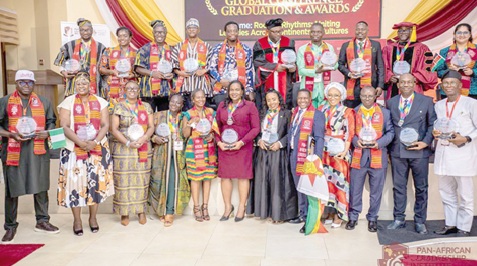
The institute graduated about 369 senior leaders from 28 countries who completed 14 courses last year.
The institute has, since its establishment in 2021, seen more than 1,400 leaders from Africa, the Caribbean, Europe, the Americas, the Middle East, and Asia complete courses in Personal MBA, Entrepreneurial Leadership, Corporate Leadership, Professional Women's Leadership, Diplomatic Leadership, Political Leadership, Youth Leadership, Religious Leadership, among others
The graduation was on the theme: “Roots and rhythms: uniting legacies across continents and cultures”.
Dr Severin commended the graduates for their efforts in attaining the new feat, adding, “Your success is both personal and collective, continental and regional.
It honours the resilience of our ancestors and advances the promise of our descendants”.
He announced a strategic partnership between the university and the Institute aimed at strengthening leadership across Africa and the Caribbean.
Dr Severin described the partnership as arriving at a pivotal moment as the Global South asserted itself more prominently in global affairs.
He said colonial structures intentionally separated African and Caribbean peoples, a fracture that universities and institutions must now help to repair.
“As an activist university, and as the Caribbean’s number one institution of higher education, we have a fundamental obligation to lead the charge of intellectual decolonisation,” he added.
He further urged graduates to lead with wisdom, integrity and purpose, adding, “What history once separated us across the Atlantic, leadership must now reunite.”
Model
The President of PALI, Dr Kofi Osei Kusi, said the institute had broadened its curriculum with new specialised offerings introduced this year, including courses in military and public service leadership, board leadership, financial leadership, and healthcare leadership.
Dr Osei Kusi said these programmes move beyond instruction to building community, activating deep wisdom, and rekindling a sense of mission, service, unity and integrity among leaders.
He urged the graduates to write a new chapter for the continent characterised by values, collaboration and shared destiny.
