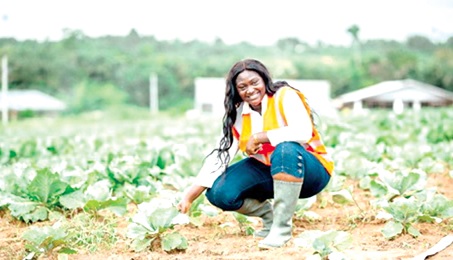
Improved seeds, improved harvests: The future of farming in Ghana
For years, Ghanaian farmers have struggled with unpredictable rains, pests, and rising costs of inputs that make it difficult to produce enough food.
Now, a growing number of them are turning to improved seeds, varieties developed through modern science to withstand drought, resist pests, and boost yields.
While many celebrate the results, the transition has not been without challenges.
Cost, access, and awareness remain barriers that shape farmers’ experiences with these seeds.
Doubled harvest
Esther Kyerewaa Twumasi, a farmer and founder of Miss Agriculture Ghana, shared her first-hand experience of what science-backed seeds can do.
She began using them three planting seasons ago, and the difference, she says, has been remarkable.
“Since then, my harvest has doubled compared to when I used the traditional seeds.
The crops mature faster, and they look healthier and more uniform,” she said.
For her, the benefits extend beyond yield. Improved seeds have made her farm more resistant to pests and diseases, reducing the amount she spends on chemicals.
“The biggest benefits are higher yields and better resistance to pests and diseases.
I also spend less on chemicals because the crops don’t get attacked as much.
And since the harvest is bigger and of better quality, I earn more when I sell in the market.”
Her experience reflects a broader pattern. According to the Ministry of Food and Agriculture (MoFA), farmers who adopt improved maize seeds in Ghana record yield increases of between 40 and 60 per cent compared to local varieties (MoFA, 2023).
A massive jump
A former Head of Public Relations at MoFA, a farmer and agriculture enthusiast, Bagbara Tanko, also attests to the power of improved seeds.
“I started using improved seeds in 2018, when the government introduced the Planting for Food and Jobs programme.
With traditional seeds, you could only harvest about three or four bags per acre. But with improved seeds, we recorded up to 25 bags per acre.
That is a massive jump,” he said.
For him, the benefits are not only about yields. “You don’t need to worry about storing seeds for the next season.
With improved seeds, you just go to agro-input shops, where the seeds are stored at the right temperature and tested for germination.
“Many are drought- and disease-resistant, unlike traditional varieties.
And when you apply fertiliser at the right rate, the crops are stronger and healthier, which leads to good yields,” he said.
But like Esther, he also raised concerns about cost. “The improved seeds are expensive because in Ghana, we mostly produce foundation seeds.
“The high-yielding hybrid seeds are usually imported, and that makes them more costly than traditional seeds,” he explained.
Bagbara stressed the importance of government support, saying, “Seed is the basic factor of production.
If you get the seed wrong, the whole farming process fails. Government should therefore prioritise subsidising seeds so that farmers can afford the right varieties.”
Government support
Both Esther and Bagbara believe government intervention could make a big difference.
Subsidies, they argue, would enable more smallholder farmers to access improved seeds, while training and closer distribution centres would help ensure they are used effectively.
Esther suggested that policymakers should think beyond short-term supply.
“I would like the government to subsidise the price of these improved seeds, especially for smallholder farmers like us.
“It would also help if extension officers gave us more training on how to use them properly, and distribution centres were closer to our communities so we do not travel far to get them,” she said.
Bagbara, for his part, added that “Government must treat seed as the foundation of agriculture.
If we don’t support farmers to access quality seeds, then we are undermining productivity from the start.”
The bigger picture
Experts argue that biotechnology and improved seed varieties are vital tools in addressing Ghana’s food security challenges, particularly as climate change intensifies droughts, floods, and pest infestations.
For example, the Food and Agriculture Organisation (FAO) projects that Africa’s food demand will triple by 2050, making productivity improvements urgent (FAO, 2021).
Improved seeds have the potential to transform agriculture but only if they reach the farmers who need them most, at the right time, and with the right support.