
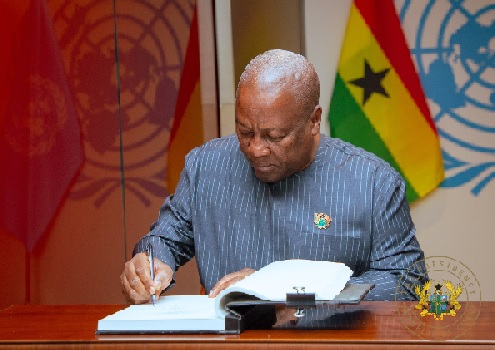
President John Dramani Mahama has expressed strong support for a United Nations General Assembly resolution recognizing the transatlantic slave trade and the enslavement of Africans as the gravest crime against humanity.
In a statement shared on his X Account on Thursday, March 26, President Mahama described the resolution as a historic and meaningful step, particularly as it coincides with global remembrance efforts for victims of slavery.
He emphasized that the achievement reflects years of advocacy and international cooperation, driven by a coalition led by the African Union and CARICOM, alongside other partners committed to justice and historical recognition.
President Mahama noted that the resolution affirms the suffering of nearly 13 million Africans who were trafficked and enslaved, marking a significant moment in acknowledging the scale and severity of the injustice.
He also framed the development as a powerful tribute to the memory of those affected and a step toward restoring their dignity and humanity.
Referencing François-Dominique Toussaint L’Ouverture, a key figure in Haiti’s liberation from slavery, Mahama highlighted the enduring importance of unity in confronting historical and systemic oppression.
He called for continued global solidarity in addressing the legacy of slavery and ensuring that the voices and experiences of those who suffered are fully recognized.
Overall, President Mahama’s statement underscored the resolution as both a symbolic and moral milestone, reinforcing the need for unity, remembrance and ongoing efforts to confront the historical impact of slavery.
Background
The United Nations General Assembly on Wednesday, March 25, 2026, officially recognised the transatlantic slave trade as “the gravest crime against humanity,” in a landmark resolution proposed by Ghana and backed by 123 member states.
The move, aimed at promoting healing and reparative justice, urges countries to consider formal apologies and contribute to a reparations framework, though it does not specify financial amounts.
The resolution entitled, “Declaration of the Trafficking of Enslaved Africans and Racialised Chattel Enslavement of Africans as the Gravest Crime Against Humanity”, was overwhelmingly adopted by the UN member states.
It saw 123 countries vote in favour; 52 countries abstained from voting, while three countries, namely the USA, Israel and Argentina, voted against the resolution.
The adoption of the resolution means the transatlantic slave trade and slavery can now be called the gravest crime against humanity and set the tone for legitimate pressure for reparative justice and the return of stolen artefacts from Africa during the period of the slave trade, colonisation and apartheid.
Ghana, under the leadership of President John Dramani Mahama, moved the motion with the backing of the African Union (AU), ECOWAS and the Caribbean countries, among others.
Read President Mahama's statement below:
I am overjoyed by the adoption by the UN Gerneral Assembly of the resolution declaring the trafficking of enslaved Africans and racialised chattel enslavement of Africans as the gravest crime against humanity.
The process of its realisation, from idea to reality, was made possible by the solidarity of people of good conscience around the world and led by the active coalition of the African Union, CARICOM and other groups.
I cannot think of a better way to honour our forebears on the day of remembrance than to have the majority of the world’s countries affirm that the trafficking and enslavement of nearly 13 million human beings is, indeed, the gravest crime against humanity.
One of those forebears, François-Dominique Toussaint L’Ouverture, who was born into slavery but became one of the architects of Haiti's liberation, the first independent nation in Latin America and the Caribbean, said: “The greatest weapon against oppression is unity.”
We must stand united in seeking the restoration of the humanity and dignity of our forbears who were enslaved and sold. #RememberingSlavery
