
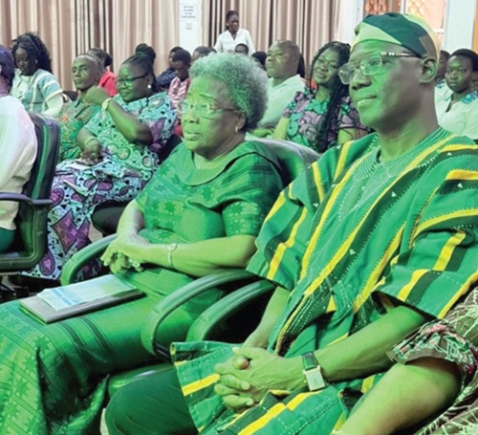
IWD 2026: Literacy, a smart investment for closing gender gap — Mrs Amissah-Arthur
The Wife of former Vice-President, Paa Kwesi Amissah-Arthur, Matilda Amissah-Arthur, has called on Ghanaians to prioritise women’s education and literacy as a key driver of national development.
She explained that empowering women through access to knowledge, mentorship, and learning opportunities created ripple effects that benefitted not only themselves but also their families and communities.
“Equality is not a favour, it is a smart investment.
When we uplift a woman, we stabilise and advance an entire community. Education is not a policy priority; it is a national survival strategy.
I have seen a lot of women in leadership roles help girls and younger women provide communication skills, as well as basic interventions, that give them opportunities to advance.
A lot of these women have created spaces for other women to rise, ensuring that progress is shared,” she said, enumerating the broader societal impact of closing the gender literacy gap.
She was speaking at a forum in Accra yesterday to commemorate this year’s International Women's Day (IWD).
Forum
The forum, organised by the Ghana Library Authority (GhLA), was on the theme: “Her Voice in Libraries: Women Transforming Literacy in Ghana”.
It brought together several high-profile women, librarians, educators, policymakers and other stakeholders in the knowledge and education sector to celebrate the contributions of women to literacy, learning and access to information in Ghana.
The event also featured a panel discussion on the theme: “The Role of Women in Addressing Literacy Gaps”, where experts, educators, and community leaders shared insights on promoting access to quality education, empowering girls and women, and using libraries as platforms to bridge literacy disparities across Ghana.
Engines of change
Mrs Amissah-Arthur, who is a former President of the Ghana Library Association, stressed the importance of libraries as engines of change, urging librarians and teachers to create safe, inclusive spaces that would encourage girls to explore STEM, ICT, and other traditionally male-dominated fields.
She also commended women leaders, librarians and authors who had championed literacy in the country.
She equally called on men to partner in the effort, reminding them that gender equality was a shared responsibility.
With over 4.6 million Ghanaian women still unable to read, she described literacy not as a national survival strategy, urging bold action to ensure no girl was left behind.
GhLA’s investment
The Executive Director of the Ghana Library Authority (GhLA), Alhassan Ziblim Bentitiche, said women would remain central to the growth of libraries and literacy in Ghana as librarians, educators and community leaders.
He emphasised that women had been at the forefront of reading programmes and digital literacy initiatives, and stressed the need to support their leadership and professional development.
In that vein, Mr Bentitiche said the authority was investing in a Critical Female Librarian Capacity-Building Programme to empower women in librarianship.
The initiative, he explained, would strengthen ICT skills, leadership development and information literacy, while promoting research and professional growth.
It will also include mentorship, training programmes, workshops and collaborations to bridge the digital skills gap.
“Our goal is simple but powerful: to ensure that every woman in our libraries has the opportunity, support and confidence to grow, lead and innovate,” he added.
Empowerment gateway
The Chief Director of the Ministry of Education, Lydia Essuah, emphasised that literacy was the gateway to empowerment for women, enabling critical thinking, economic participation, and societal transformation.
She mentioned the pivotal role of libraries in providing safe, inclusive spaces and access to quality knowledge, especially for underserved communities.
Mrs Essauh added that while the country had achieved gender parity at the basic level, there was a need to improve progression, higher education participation, mentorship, and digital literacy to fully unlock women’s potential.
“Let us continue to strengthen girls' education and empower women to break barriers and redefine possibilities.
Because when women's voices are heard, societies become stronger. When women are educated, nations prosper,” she said.
