
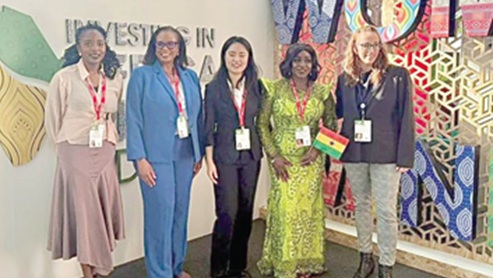
Make financing women national policy - Dr Bisiw-Kotei to African govts
The Administrator of the Minerals Development Fund (MDF), Dr Hanna Louisa Bisiw-Kotei, has said that financing women should be a deliberate national economic strategy for every country, rather than a gender issue.
She said that financing women had a greater consequential effect on the national development of any country, hence, the need for deliberate actions to promote women’s participation in economic developments.
Dr Bisiw-Kotei was speaking at the Association of Women in Mining Africa (AWIMA) Leadership Awards and Conference in Cape Town, South Africa, on the theme: “Financing women’s participation in mining: Government’s instrument for inclusive development”.
Role of governments
She also underscored the critical responsibility of governments and public institutions in dismantling financial barriers that continue to limit women’s full participation across the mining value chain.
"When we finance women, we do not just empower individuals, we strengthen families, stabilise communities, and secure the foundations of national development," the administrator added.
Dr Bisiw-Kotei, therefore, challenged stakeholders to move beyond symbolic commitments and embed women's access to capital, equipment, land, technology, and markets within national mining frameworks.
"Financing women is not charity, it is nation-building. It is the government's most practical instrument for inclusive development," she said.
The administrator added that women’s access to capital, equipment, land, technology, and markets must be deliberately embedded within national mining frameworks.
Coordinated action
Dr Bisiw-Kotei further called for coordinated action across the mining ecosystem, which is largely dominated by men, to enhance women's inclusivity in the sector.
She urged governments, regulators, financial institutions, and private sector actors to allocate resources intentionally toward women-led mining enterprises, design gender-responsive financing frameworks, and equip women technically through targeted skills development programmes.
Dr Bisiw-Kotei said women-led mining enterprises had consistently demonstrated strong community reinvestment patterns, higher social accountability, and inclusive employment practices, making them vital partners in sustainable development.
She added that, given the impact of the few women in the mining sector, positioning women’s participation should not be treated as an optional social objective but as a strategic pillar for the future of Africa’s mining sector.
Actions
In framing government financing as a transformative development instrument, the administrator said she had placed women at the centre of Africa’s mining future.
This vision, according to her, aligned strongly with the leadership direction of the President of Ghana, John Dramani Mahama, who is finalising arrangements to officially launch a Women’s Development Bank.
This, she said, represented a bold and strategic national intervention designed to expand access to capital for female entrepreneurs across key sectors, including mining.
“The bank is expected to serve as a core source of sustainable financing for women-led enterprises, unlocking new opportunities for participation, ownership, and growth within Ghana’s mineral value chain,” Dr Bisiw-Kotei said.
