
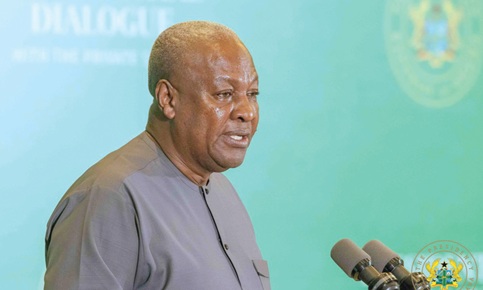
Moving beyond stabilisation to structural reforms is our vision - President assures private sector
President John Dramani Mahama has said that the nation’s economic transformation depends on moving beyond mere stabilisation to structural reforms.
He said this could be achieved through strategic partnership between the government and the private sector, adding that “stabilisation is not equal to transformation.
We need to change our trajectory”.
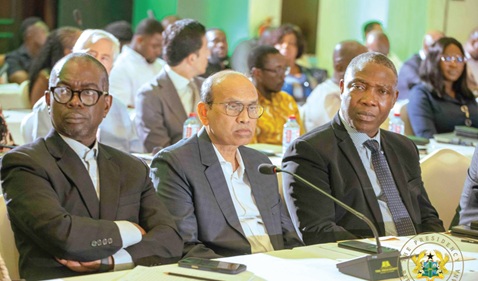
Addressing a gathering of private sector business leaders, ministers of state and heads of state agencies in Accra on Monday night, the President outlined his vision to reposition the country as the production hub in West Africa, anchored by a new national target; increasing the manufacturing sector’s contribution to Gross Domestic Product (GDP) from its stagnant 10 per cent to at least 15 per cent by the year 2030.
“For over five decades, Ghana's manufacturing sector has contributed around 10 per cent to GDP. Meanwhile, Asian economies starting from a similar basis have achieved manufacturing shares of 20 per cent to 30 per cent of GDP, creating mass employment and export competitiveness,” he said.
The event served as a platform for the President to acknowledge the economy’s recent recovery, citing currency stabilisation, improved investor sentiment and new capital investments.
He described the achievements as positive signals the government would build upon.
Energy reforms
President Mahama also identified prohibitive cost and reliability on power as the single most dominant constraint across all sectors, saying “no industrial nation thrives under structurally high cost of power”.
He announced a suite of energy sector reforms which included an accelerated restructuring of energy sector debt, expanding renewable energy generation, introducing differentiated off-peak industrial tariffs and promoting embedded generation within industrial enclaves.
“Energy reform is not optional. It is foundational to Ghana’s industrial take-off,” the President added.
He also promised private sector participation in the provision of industrial water.
President Mahama further pledged to tackle the high cost of borrowing by establishing dedicated financing windows for the manufacturing sector in partnership with the Bank of Ghana and development finance institutions.
Tackling smuggling
President Mahama labelled smuggling, under-declaration and the dumping of counterfeit goods as “economic sabotage”.
He vowed to intensify coordinated border enforcement, prosecute public officers found culpable and deploy technology-driven customs surveillance to protect fledgling local industries.
The President also outlined specific actions for key sectors, including textiles, pharmaceuticals, cement, steel and food and beverages; ranging from tax exemptions on machinery and mandatory local procurement compliance to cracking down on rebagging of inferior products and enforcement of standards.
Cocoa sector
The President described the current crisis in the cocoa sector as a catalyst for urgent, comprehensive reform across the entire value chain.
It includes introducing an automatic price mechanism that guarantees farmers 70 per cent of the international market price, expanding the role of local licensed buying companies and drastically reducing waste and expenditure at COCOBOD.
“We must move Ghana from a raw commodity exporter to a value-added producer,” he said, adding that the measures would be extended to the extractive industry to process all mineral ores locally within five years.
There would also be the establishment of litigation-free industrial land banks and reformed land tenure systems to support commercial contract farming.
President Mahama further described the 24-Hour Economy as a policy which offered shift-based incentives, including cheaper peak-hour electricity and tax exemptions.
He also described sports and recreation as a fundamental economic sector, pointing to its influence on global markets, media rights and youth employment.
The President announced the establishment of the Ghana Sports Fund, a transparent financing framework for grassroots development and athletes welfare.
