
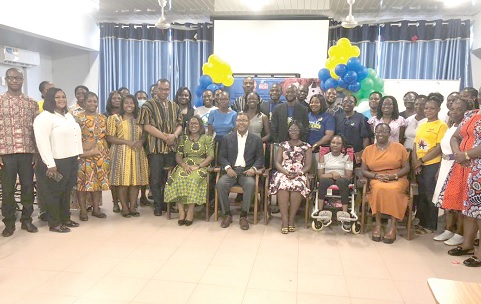
Patient Organisation for Primary Immunodeficiencies launched
The Ghana chapter of the Patient Organisation for Primary Immunodeficiencies (GhanaPOPI) has been launched to create awareness about primary immunodeficiency disorders (PID) that weaken the immune system.
It is also aimed at getting stakeholders, particularly healthcare professionals and primary caregivers, to collaborate more to ensure effective care for patients.
Coinciding with the World Primary Immunodeficiency Week, the event held at the Korle Bu Teaching Hospital last Wednesday brought together health professionals, patients and families to push for early diagnosis, timely treatment and stronger support systems for people living with primary immunodeficiency (PID).
PID
There are 550 rare, chronic, genetic disorders where part of the immune system is missing or malfunctioning, leading to increased susceptibility to frequent, severe, or persistent infections.
World Primary Immunodeficiency (PI) Week, observed from April 22 to 29, raises awareness about Primary Immunodeficiency Disorders (PID) that weaken the immune system.
The theme for this year, “We Can’t Wait”, calls for urgent action to close gaps in diagnosis, treatment and care.
Focus
A member of GhanaPOPI, Dr Richard Bright Danyoh, said the organisation had been established as the national patient organisation for persons living with PID in Ghana.
He said the organisation was affiliated to the International Patient Organisation for Primary Immunodeficiencies (IPOPI), which effectively linked Ghana to a global advocacy network.
Dr Danyoh said the organisation would focus on awareness creation, patient support and policy advocacy to improve access to care.
Awareness, support
A Senior Specialist Paediatrician at the Cape Coast Teaching Hospital, Dr Yemah Mariama Bockarie, said awareness of PID remained low despite its impact.
She said PIDs often presented as persistent, recurrent and severe infections that were frequently missed.
The Senior Specialist Paediatrician said challenges include limited diagnostic capacity and high treatment costs.
Dr Bockarie, who is also a Paediatric Infectious Disease sub-specialist, said many patients remained undiagnosed for years.
“Awareness is critical. Early diagnosis saves lives; unfortunately, many affected individuals are trapped in uncertainty and poor health,” she said.
She, however, said linking patients to support systems could improve outcomes; hence, the need for collaboration among stakeholders to strengthen care systems.
“Establishing a diagnosis and linking patients to support groups transforms lives. Closing the gap means working together,” she said.
Story, advocacy
Sharing his experience as a parent of a child with PID, Sylvester Yirenkyi said his son, Elorm, suffered from Wiskott–Aldrich syndrome, a rare immune disorder.
“Almost every week or two, sometimes within a week, we could come for two admissions,” he said.
Mr Yirenkyi said the illness began early in his son’s life, intimating that despite repeated hospital visits, it was difficult to access treatment.
“For about three weeks, every day, I would drive to get platelets. Sometimes you come, and they tell you there are none.
“A light from our lives is gone. A voice we loved is still,” Mr Yirenkyi, who described his presentation as a tribute, said.
Mr Yirenkyi said his experience pushed him into advocacy.
“I didn’t know of PIDs… not until my child suffered it,” he said, giving an assurance of his commitment to awareness creation.
