
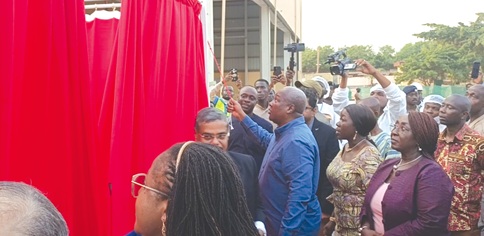
President Mahama inaugurates Olam Agri Ghana pasta facility
President John Dramani Mahama has inaugurated the new Olam Agri Ghana pasta manufacturing facility, a landmark project aimed at increasing local food production, creating jobs, and reducing Ghana’s reliance on imported processed foods.
The inauguration marked a significant milestone for Olam Agri Ghana, reinforcing its commitment to innovation, sustainability, and food security, while setting the stage for further investments in the country’s agro-processing sector.
The Olam Group, which has operated in Ghana for 32 years, has grown from commodity trading into agro-processing and food manufacturing, with operations spanning cocoa, cashew, grains, wheat milling, biscuits, and tomato processing.
The company employs over 4,500 Ghanaians directly and indirectly.
Speaking at the ceremony last Thursday at Kpone in the Greater Accra Region, President Mahama underscored the strategic importance of such investments in transforming Ghana’s industrial and agricultural sectors.
“Facilities like this represent a shift from reliance on imports to local production, from missed opportunities to targeted industrial growth,” he said.
“They address issues that touch every Ghanaian household: the cost of food, household incomes, foreign exchange pressures, and the availability of locally produced alternatives,” he added.
Industrial revolution
The pasta factory forms part of a series of recent industrial projects commissioned by the government, including the world’s largest calcined clay cement plant in Tema, the expansion of the Shama Ceramic Tile Factory, and the country’s first gas processing facility.
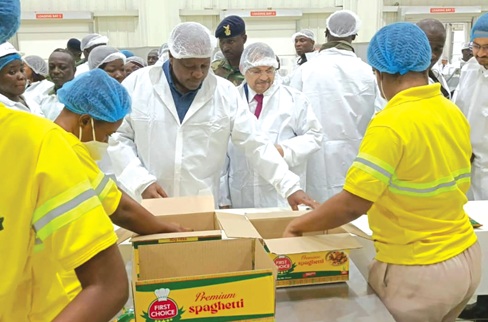
President John Dramani Mahama observing the production process in the new pasta factory
These projects, President Mahama said, were designed to harness local resources, generate employment, and foster sustainable industrial growth.
President Mahama emphasised that the pasta factory, the latest addition, would strengthen local supply chains by creating jobs for farmers, transporters, technicians and small businesses.
He also highlighted agricultural innovation, indicating that the Council for Scientific and Industrial Research's Crops Research Institute had developed a wheat variety suitable for local cultivation, capable of yielding five to six tonnes per hectare.
“We will work with Olam Agri to integrate locally grown wheat into the pasta value chain,” he said.
He explained that the inauguration aligned with the government’s Agriculture for Economic Transformation agenda and the 24-Hour Economy Initiative, which supported duty-free importation of equipment and continuous factory operations.
The President urged the company’s management to sign onto the programme and benefit from its incentives, including tax waivers on the importation of new equipment.
President Mahama said Ghana was among the largest consumers of pasta in Africa, but had historically relied heavily on imports.
Impact
The Minister of Trade, Agribusiness and Industry, Elizabeth Ofosu-Agyare, said with an annual production capacity of 60,000 metric tonnes, the factory was projected to meet a substantial portion of domestic demand, conserve foreign exchange, and create jobs for Ghanaian youth.
Mrs Ofosu-Agyare also underscored the government’s commitment to industrialisation, value addition and competitive manufacturing.
“Today’s commissioning is proof that the economic reset agenda is not merely rhetoric; it is delivering tangible results.
Ghana imported approximately $140 million worth of pasta from 2021 to 2024, making it the second largest importer on the continent behind Togo.
This $40 million state-of-the-art facility will change that picture significantly,” she said.
Growth
The Co-Founder and Group Chief Executive Officer (CEO) of Olam Group, Sunny Verghese, highlighted the company’s remarkable growth since its founding in Nigeria 37 years ago.
Today, the company operates in 70 countries, including Ghana, employing about 90,000 people and generating approximately $50 billion in revenue in 2025 alone.
“This African-born multinational has grown, thanks to the support of governments, partners, and local communities, and Ghana remains central to our strategy,” he said.
He explained that the new pasta facility, with an initial capacity of 40,000 metric tonnes per year, was expected to meet a substantial portion of domestic demand and would be expanded in the near future to double output.
Mr Verghese emphasised that Olam Agri’s mission extended beyond production.
Expansion
In his welcome address, the Country Head of Olam Agri Ghana, Balbhav Biswas, recalled that the company established its presence in Ghana in 2014 and praised the completion of the project despite ambitious timelines.
He said the construction of the facility commenced in October 2024.
Built with modern infrastructure and machinery from global partners, the project has created about 300 direct jobs and many indirect jobs, with plans to expand production to neighbouring countries.
“This facility is not just a factory; it is a symbol of local production, economic growth and regional impact,” Mr Biswas said.
“It delivers world-class pasta, made in Ghana, for Ghana and beyond,” he added.
Writer’s email:
