
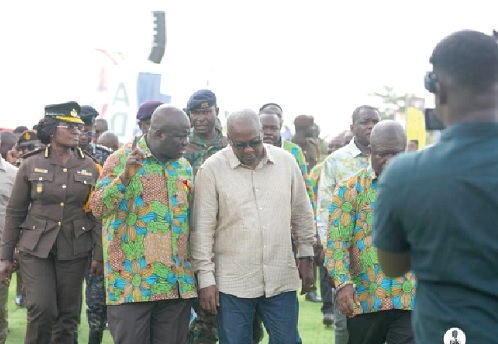
President pledges single-digit interest rate loans for farmers
President John Dramani Mahama has pledged that his administration will work to provide agricultural credit at single-digit interest rates to boost production and ensure national food security.
He said the current situation, where farmers accessed capital at high interest rates, meant they "virtually will be working for the bank, not for themselves".
The President made the pledge when he addressed the 2025 National Farmers Day celebration in Ho last Friday, where he also announced a significant drop in the national food inflation rate from 28.3 per cent in January to 9.5 per cent as of October this year.
Speaking on the theme: “Feed Ghana, Eat Ghana, Secure the Future”, President Mahama unveiled a comprehensive “Feed Ghana” programme aimed at modernising agriculture, creating jobs, reducing food inflation and fostering rural industrialisation.
The programme, he said, would develop value chains in key crops and livestock, expand irrigation, establish farmer service centres, and improve storage and agro-processing.
“A sustained transformation of the agricultural sector requires well-designed, comprehensive, and sequenced interventions implemented with discipline and commitment. And so the Feed Ghana programme embodies exactly this approach,” President Mahama stated.
Event
The National Farmers Day celebration returned to the Volta Regional capital since 2019, with the Agbogbomefia, Togbe Afede XIV, as the chairperson.
It featured an exhibition of Ghana’s agricultural pride, a variety of dishes from local produce, speeches and cultural displays.
In attendance were politicians, the clergy, students, academia, and members of the public.
Key interventions
On irrigation, the President said 3,520 hectares were being developed under the Irrigation for Wealth Creation Initiative, with significant work also ongoing on the Afram Plains enclave.
He added that the Ministry of Agriculture was set to distribute solar water pumps to enable year-round farming.
“Even if you have a 10-acre farm, we will drill a borehole for you. We will install a solar water pump. You don’t need electricity. It will supply you with water so that you can do year-round agriculture,” he explained.
To tackle post-harvest losses and improve mechanisation, the government has finalised agreements for the supply of 5,500 agricultural machines and is establishing 50 Farmer Service Centres across the country.
Prioritising local produce
President Mahama reiterated a directive for the School Feeding Programme to procure food items locally.
“It is unacceptable that suppliers of the School Feeding Programme buy rice from Vietnam to feed our schoolchildren, when Ghanaian farmers are sitting with rice inventories from last year,” he said.
He commended local scientists for developing improved crop varieties, such as a new weevil-resistant cowpea, adding that the National School Agriculture Programme, which will engage educational institutions in food production, will soon be launched.
Tribute to farmers
The President further paid glowing tribute to the nation’s farmers and fishers, describing them as “the true custodians of Ghana's food security” who persevere despite challenges.
He ended with a call for all Ghanaians, including public officials, to take up farming, stating: “Agriculture is profitable and agriculture brings good incomes, and that's why even as President, I am a farmer. And so everybody can be a farmer.”
Revitalisation policies
Togbe Afede XIV, in his remarks, lauded farmers, fishers, processors and all value chain actors for their unwavering dedication to ensuring food security, generating foreign exchange earnings and sustaining livelihoods across the country.
He, however, expressed deep concern over declining productivity in several critical agricultural sectors, particularly cocoa, cotton and coffee industries that once significantly powered Ghana’s economy, emphasising that these crops have historically been pillars of national development, and stressed the need for stronger state intervention, research investment and revitalisation policies to restore growth and competitiveness.
The Agbogbomefia of Asogli commended the government’s $10 billion Big Push Programme, describing it as a transformative initiative that, when fully implemented, will significantly enhance roads and critical infrastructure in rural farming communities.
Other awardees
Cecilia Addae from Sankore District in the Ahafo Region was adjudged the Most Enterprising Female Cocoa Farmer, while Aminatu Sulley from the West Mamprusi District in the North East Region emerged the National Best Sheanut Picker.
Kwasi Gyan from Techiman District in the Bono East Region won the National Best Coffee Farmer.
The National Best Fisheries Extension Officer in the Northern Zone award went to Israel Hanson Arthur from Kintampo in the Bono East Region, while Esther Boateng from Adansi in the Ashanti Region claimed the same award for the Southern Zone.
Margaret Ahadjitse from Bantama Mbofrakyinu in the Central Region was adjudged the National Best Fish Processor.
Kofi Adukpo from Abodwesekrom in the Bono East Region was named the National Best Inland Fisher, while Richard Ditton from Kongo in the Upper East Region took the award for the National Best Fish Farmer.
Clement Sewornu from Ketu South District in the Volta Region was honoured as the National Best Marine Fisher.
