
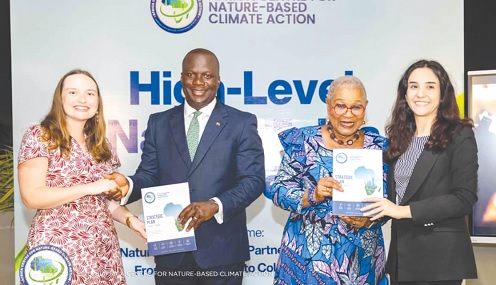
Protecting natural ecosystems key to addressing climate impacts — Activists, experts
KEY climate activists and stakeholders have stressed the need for robust measures to protect the country's natural resources from destruction.
They noted that safeguarding the country’s rich natural resources, particularly forests, wetlands, mangroves and water bodies, would contribute significantly to addressing the global climate crisis.
Again, they said the destruction of the environment, particularly through illegal mining, if not tackled through a multi-stakeholder approach, could worsen the climate impact on communities.
Among those who made the call were the Global Lead of the Africa Centre for Nature-Based Climate Action (AC4NCA), Samuel A. Jinapor; the Pro Vice-Chancellor of the University of Ghana, Professor Gordon Awandare; the Danish Ambassador to Ghana, Jakob Linulf and the Ambassador and Head of Delegation of the European Union (E.U), Rune Skinnebach.
They made the call in separate statements at the "Nature Talks" soiree hosted by AC4NCA in Accra last Wednesday.
The high-level event organised by the AC4NCA brought together key stakeholders, including government officials, civil society organisations (CSOs), academia, and the diplomatic community.
The discussions centred on how the stakeholders could work together for collective action that leverages nature-based solutions to tackle climate change.
Strategic plan
At the Nature Talks event, the AC4NCA launched its five-year strategic plan (2025-2030) for building a climate-resilient and nature-positive continent through innovative partnerships and action.
The strategic plan is anchored on five key pillars - policy and advocacy; restoration and implementation; research, data and technical knowledge; capacity building, youth and community empowerment; and communications, storytelling and partnerships.
The policy is focused on mainstreaming nature-based solutions (NBS) into national climate and land-use policies. It also seeks to establish an NBS knowledge and data hub, while strengthening the capacities of national and subnational actors.
Natural resource potential
The Global Lead for AC4NCA, Samuel A. Jinapor, stressed that nature remained one of the greatest allies in the fight against climate change and needed to be protected.
He explained that Africa’s natural capital, its forests, wetlands, mangroves, grasslands, and rich biodiversity landscapes were among the most valuable assets in the global response to climate change.
“These ecosystems are not only essential for carbon sequestration, but are also indispensable for sustaining livelihoods, preserving biodiversity, and strengthening resilience,” he said.
The former Minister of Lands and Natural Resources explained that nature-based solutions were critical because they offered a pathway to simultaneously address mitigation, adaptation, ecological restoration, and sustainable development.
“More importantly, they present an opportunity to deliver climate action in ways that are locally grounded, socially inclusive, and economically transformative,” he said.
He said the complexity and urgency of the climate crisis demanded broad-based collaboration between governments, civil society, development partners, the private sector, academia, and local communities.
The former minister stressed that handling the complexity of the climate crisis required stakeholders to work across sectors and across borders, “united by a common vision for a more sustainable and resilient future.”
He said it was in that regard that the AC4NCA instituted the Nature Talks initiative to provide a platform to bridge perspectives, align priorities, and strengthen the collective resolve required to scale solutions that were both ambitious and practical.
“Real progress will require governments, civil society, the private sector, development partners, women, young people, and local communities working together with urgency, tenacity and vision,” he stressed.
Collaboration
Prof. Awandare described the Nature Talks initiative by AC4NCA, which brought together key actors in the climate space, as a masterstroke, saying it ensured that diverse experiences and knowledge were harnessed to promote the use of nature-based solutions to address climate change.
He emphasised that academia was prepared to work with industry players and government institutions for coordinated climate action, adding that the University of Ghana would continue to contribute human resources and cutting-edge research in the field of climate change for the benefit of the country.
Prof. Awandare said the university was more focused on streamlining climate work and creating synergies for more impactful climate action.
He added that the university had also rolled out a project to build the capacity of young graduates to upscale their degrees in climate change.
Again, he said the institution was supporting young people with innovative ideas to create jobs within the climate space.
"If we are to achieve our goals of addressing climate change, we cannot be working in silos; we must build networks," he said.
Galamsey
The EU Ambassador said climate change is a fundamental threat to human existence and requires integrated measures to cope with its impacts.
He said the EU recognised Ghana's stride to become climate-resilient and would support it in all ways.
Mr Skinnebach stressed that there was a need for concerted efforts to stop galamsey, which was destroying the country's natural resources.
In his view, galamsey was the greatest threat to Ghana's green agenda and must be tackled head-on.
"Galamsey destroys both land and water resources and poses an existential threat. It must be tackled well to save the environment," he said.
The Danish Ambassador also said green infrastructure and the sustainable management of natural resources were key to building climate resilience.
He also underscored the need to strengthen systems for promoting the green agenda in the agriculture value chain.
