
Remote Control culture: Who tells Ghana’s stories now?
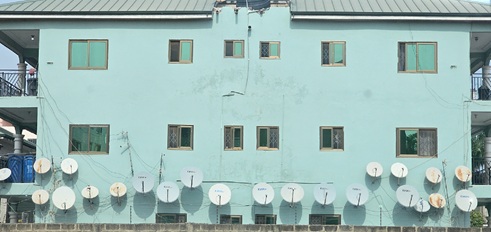
An apartment block stands quietly behind a low concrete wall in Tetegu, a suburb within the Weija Gbawe Municipality.
At first glance, it is ordinary—two floors, modest balconies and green-tinted windows.
But a closer look reveals a façade that tells a larger story.
Satellite dishes bloom across the building like metal sunflowers, dozens of them tilted upward in careful alignment, all waiting for signals that beam different cultures into living rooms.
Once upon a time in Ghana, television was communal.
A single set drew neighbours together to watch news in familiar accents, dramas that mirrored everyday life, and music shows filled with highlife and gospel rhythms.
Today, behind every window sits a different world—Turkish soap operas in one room, European football in another, animated cartoon series elsewhere.
Inside many homes, the remote control has become the most contested object in the living room.
Children argue over who gets to hold it and decide what everyone watches, each drawn to programmes from far beyond Ghana’s borders.
Many can easily name foreign cartoon heroes, yet struggle to recall characters from Ghanaian folklore once passed down through fireside storytelling.
Digital broadcasting has collapsed distance. From this quiet corner, viewers can travel from Lagos to London, and from Mumbai to Los Angeles without leaving their sofa.
With those signals come new fashions, cultures and aspirations—evidence of how easily influence now crosses borders.
Yet the dishes on this building can also be read differently.
The same satellites that import global entertainment can carry Ghanaian stories too—films in Twi, Ga, Ewe and other languages, music from local artists and narratives rooted in communities like this one.
That reflection is especially fitting as we celebrate Ghana Month, observed every March to project our identity through local languages, traditional food, music, dress and heritage as part of our Independence anniversary.
If Ghana Month urges citizens to celebrate their identity, the scene here poses a timely question: can that cultural mission thrive in an age when the world streams endlessly into our homes?
The answer may not lie in resisting foreign signals, but in ensuring that Ghanaian stories travel just as powerfully through them.
Who will ensure that Ghana’s own stories remain strong enough to be heard?
Because inside this apartment block—and in many homes across the country—the future of Ghana’s cultural identity is being negotiated every day, one channel, one programme and one remote control at a time.
