
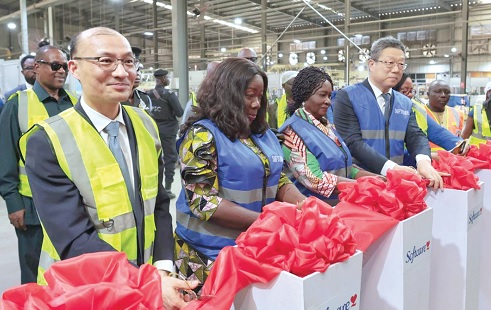
Reset agenda prioritises local industries — Vice-President
The Vice-President, Prof. Naana Jane Opoku-Agyemang, has said that the government’s economic reset agenda prioritises local manufacturing to promote import substitution, value addition and job creation.
She also said that the government was committed to reshaping the country’s economy under the Ghana Framework for Industrialisation, Revitalisation, Support, and Transformation, which is deliberately structured to strengthen domestic production and reduce overreliance on imports.
Speaking at the commissioning of a new sanitary pad production line at Softcare Hygiene Product Factory behind the West Hills Mall at Weija, Accra, Prof. Opoku-Agyemang said the expansion of the company’s operations was clear evidence that the government’s policies on industrialisation and private sector growth were yielding results.
Present were the Minister of Trade, Agribusiness, and Industry, Elizabeth Ofosu-Adjare; the Minister of Gender, Children, and Social Protection, Dr Agnes Naa Momo Lartey; the Greater Accra Regional Minister, Linda Obenewaa Ocloo and the Ambassador of China in Ghana, Tong Defa.
The rest were the Chairman of Softcare, Shen Yanchang, and the Managing Director of the company, Michael Kofi Baako, among others.
The company later donated 50,000 sanitary packs to the government.
State of economy
Prof. Opoku-Agyemang further said that the government had significantly lowered inflation from previous highs, restored growth and achieved credit rating upgrades, thereby boosting investor confidence.
She said fiscal discipline was being restored, with a projected primary surplus creating a predictable environment for long-term private investment.
Prof. Opoku-Agyemang mentioned key measures to ease the cost of doing business in the country to include the abolition of the COVID-19 Health Recovery Levy, reduction in effective VAT rates and the digitisation of tax administration.
“Each reform is designed with one goal, and that is to make it easier and more profitable to do business in the country because when we invest in the private sector, Ghana grows,” she added.
Free sanitary pads
Prof. Opoku-Agyemang said access to affordable sanitary products remained a major barrier to education for many girls, particularly in disadvantaged communities.
Citing UNESCO estimates, she said about one in 10 girls in sub-Saharan Africa missed school during menstruation.
To address this challenge, the Vice-President announced that the government had allocated GH¢292 million in the 2026 Budget to continue with the nationwide distribution of free sanitary pads to girls in primary and secondary schools.
She said the President had further directed that all sanitary pads procured under the programme must be locally manufactured.
The directive was intended to meet the social needs of beneficiaries, support a sustainable domestic manufacturing industry, and ensure long-term access to affordable menstrual hygiene products.
Prof. Opoku-Agyemang commended Softcare for its investments in schools and hospitals while welcoming the company’s plans to expand its workforce over the next five years.
Local supplies
The Minister of Trade, Agribusiness, and Industry, Elizabeth Ofosu-Adjare, said until recently, the country imported nearly 70 per cent of sanitary products.
She said today, local manufacturers supplied more than 65 per cent of national demand, indicating that the government’s import substitution policy was working.
The minister said that the new production line was expected to save the nation about US$8 million in foreign exchange every year, and create around 400 direct jobs and more than 1,200 indirect jobs.
She added that Ghana-made products were now getting into other African markets, carrying the country’s name beyond its borders.
The minister described the partnership between the government, Softcare FM Manufacturing Ltd, and the Sundar Group as a strong public-private collaboration.
Collaboration
The Chairman of Softcare said: “We respectfully call upon the government, regulators, and all stakeholders to continue fostering a transparent and level playing field for business.
Such an environment is essential for attracting investment and ensuring sustainable growth that benefits all citizens”.
He added that “we also remain closely connected to communities and continue to promote innovation through meaningful, safe and smart initiatives.
Together, we can advance Ghana’s industrialisation and strengthen national standards”.
For his part, the Chinese ambassador expressed appreciation to the government for its support and contribution to Ghana-China bilateral cooperation.
