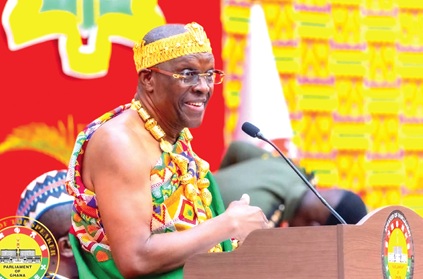
Speaker calls out aid conditionalities
The Speaker of Ghana’s Parliament, Alban Sumana Kingsford Bagbin, has asserted that conditioning aid on the alteration of domestic laws to the disadvantage of beneficiary countries violates the principle of sovereign equality enshrined in the United Nations Charter.
He said development assistance, trade agreements, national resource agreements and bilateral cooperation had been made contingent on the adoption of legal and cultural paradigms alien to the social and cultural fabric of African nations.
“Africa itself is rich and prosperous, and so there are some things that are preventing Africans from enjoying their natural wealth that God so graciously gave to us,” the Speaker said.
Respect our sovereignty
Delivering the keynote address at the Fourth Inter-Parliamentary Conference on Family, Sovereignty and Values at Parliament House yesterday, Mr Bagbin said: “We in Africa do not seek to dictate the internal legal frameworks of other continents, and we expect in turn the same respect for our sovereignty.
Our laws must look like the people they are written to protect,” he said.
The three-day continental dialogue is being held on the theme: “Consolidating parliamentary consensus: Advancing the African Charter on Family, Sovereignty and Values”.
It has brought together lawmakers, policy experts, civil society and development partners from across Africa to deliberate on emerging challenges facing African societies and on the collective responsibility of parliaments to shape responsive, people-centred policies.
The Speaker said it was urgent for African countries to preserve their values and culture as they modernised and “codify our identity in an increasingly globalised world”.
Mr Bagbin added that the people of Africa found their true meaning, protection and purpose within the sacred framework of the family.
He therefore stressed the need for Africans to approach the issue of sovereignty with maturity and legal accession.
Mr Bagbin explained that sovereignty was not a passive shield, but an active and vigorous exercise of self-definition and the inherent right of a people to determine their social, economic and moral destiny, free from external coercion or ideological conditionalities.
The Speaker cited Article 39 of the 1992 Constitution, which mandates that the state foster, preserve, and enrich its traditional and cultural values, while balancing those with the demands of modern development and fundamental human freedoms.
Similar provisions, he said, existed across virtually every other African nation.
“Our constitutions empower parliaments to act as the bridge between traditional heritage and modern statutory law.
“When African Parliaments legislate on the family, we fulfil a direct legitimate constitutional command,” he said.
Redefine African family structure
Calling on Africans to reflect their true identity and uniqueness of who they were, Mr Bagbin said any law that did not resonate with the spirit, history and moral conscience of the citizenry was a dead law.
“As African legislators, our loyalty must remain anchored to the mandates given to us by our electorate,” he said.
Moreover, the Speaker added, there was an urgent need for legislators to redefine the African family structure in the 21st century.
And in trying to do so, he said, they must avoid adopting an oversimplified or imported definition of the family.
“The Western concept of the nuclear family-- isolated, individualistic, lonely and strictly bounded-- fails to capture the expansive, resilient and self-sustaining genus of the African family.
“In Africa, a family is an intergenerational web of mutual responsibility; grandparents who carry our historical memory, aunts and uncles who share the burden of child care,” Mr Bagbin said.
Mr Bagbin pointed out that the challenges Africans faced were transnational and their response must, therefore, be collective.
In his view, no single African nation could safeguard its legislative sovereignty in isolation.
“When one country stands alone against unfair external pressures, it risks economic isolation, but when we stand together as a continent of 1.4 billion people, our voice becomes immutable,” he said.
He said they must actively utilise their legislative bodies, including Pan-African Parliaments, the ECOWAS Parliaments, the East African Legislative Assembly, and other parliamentary bodies to build a unified leadership.