
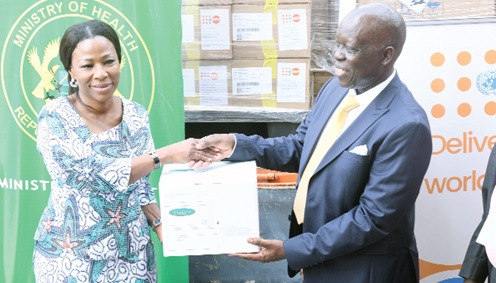
UNFPA presents medical equipment to MoH
The United Nations Population Fund (UNFPA) has presented medical equipment to the Ministry of Health (MoH) to improve maternal health, strengthen midwifery education, and expand access to quality reproductive health services.
The donation, which include midwifery training equipment worth GH¢2 million and family planning commodity worth GH¢40 million, will be distributed to two selected midwifery training institutions, the National Midwifery Training College at the Korle Bu Teaching Hospital and the Kwame Nkrumah University of Science and Technology School of Nurses and Midwifery.
The donation, a joint initiative under the Midwifery Education and Practice Centres of Excellence Programme (MEPCEP), was developed over the year 2023–2024 following a nationwide assessment led by the MoH.
The items include advanced anatomical models, simulation equipment and essential clinical items while the family planning articles are implants, injectables and condoms.
The donation is to help improve practical midwifery training and better prepare students to manage real-life maternal and newborn care situations.
Investment
The UNFPA Country Representative, Dr Wilfred Ochan, said the donation was a direct investment in the future of maternal and newborn care.
The support, he said, aligned with the country’s roadmap towards achieving Universal Health Coverage and Sustainable Development Goal 3 and UNFPA’s three transformative results, especially their commitment to ending preventable maternal deaths.
The UNFPA Country Representative raised concern over the growing gap in national contraceptive supply created by the withdrawal of USAID from procurement support, adding that USAID provided 45 per cent of Ghana’s contraceptive needs, with UNFPA supplying another 40 per cent.
“We appeal to the government to take the necessary steps to prevent this gap and ensure that women and girls in need of family planning based on consent have continued access,” he added.
“Already, unmet needs for family planning in the country stands at 23 per cent, and this gap may worsen the situation if not urgently addressed,” Dr Ochan said.
He further called on the government to fulfil its co-financing commitments under the UNFPA Supplies Partnership, which required Ghana to procure maternal health commodities worth approximately $452,000 in 2026.
The Deputy Minister of Health, Dr Grace Ayensu-Danquah, reaffirmed the ministry’s commitment to improving health professional education, adding that MEPCEP remained a key initiative driving Ghana’s efforts to elevate the standards of midwifery training.
She gave an assurance that the ministry would continue to work closely with partners such as the UNFPA to expand and strengthen the programme.
Dr Ayensu-Danquah stressed that building a strong, competent midwifery workforce began with quality training backed by modern tools and practical experience.
Safeguard
The Chief Director of the MoH, Desmond Boateng, said midwives played a vital role in safeguarding the health of mothers and newborns, and the quality of training they received directly affected the quality of care provided in health facilities.
