
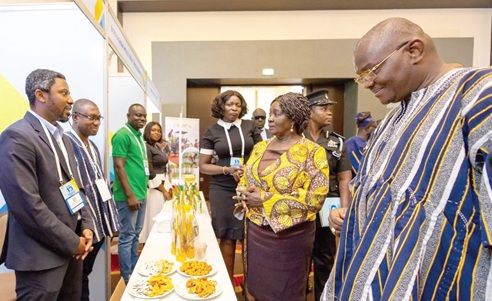
Vice-President urges GEXIM to support small and medium-sized enterprises
The Vice-President, Professor Naana Jane Opoku-Agyemang, has urged the Ghana Export-Import Bank (GEXIM) to deepen support for value addition and industrial production along the value chain to boost export competitiveness.
She also urged the bank to expand assistance to small and medium-sized enterprises, strengthen its capacity in export trade and export finance, as well as risk management systems, and enhance partnerships with international financial institutions and private investors.
Speaking at the GEXIM@10 International Conference and AGROTECH Fair 2026, she commended the bank for a significant milestone, marking a decade of support for the country’s export development and industrial growth.
The Vice-President said that the global environment in which GEXIM now operated had become significantly more complex, with rising trade tensions, shifting supply chains, geopolitical conflicts, and the growing impact of climate change and technological disruption.
She said global uncertainty was now a permanent feature, making export diversification and industrial capacity critical for resilience.
“Dependence on a narrow range of exports is no longer sustainable. Diversification is not only desirable, it is necessary.
“Countries that can offer stability, strategic location, a capable workforce, and supportive institutions will have an advantage, and Ghana is well placed to seize that moment,” the Vice-President added.
Event
The two-day commemoration conference is on the theme: " A decade of enabling export trade and industrial transformation; Resetting GEXIM for the next frontier. "
Participants would reflect on progress and prepare for future challenges. They would also exchange ideas, strengthen partnerships and convert discussions into opportunities for investment and collaboration.
They are also exploring how export finance could be enhanced through digital tools, blended finance structures and deeper public-private sector collaboration.
Present were the Deputy Minister of Trade and Agribusiness, Sampson Ahi; the Governor, Bank of Ghana, Dr Johnson Pandit Asiama; the Board Chair, GEXIM, Dr Joseph Nyarkotei Dorh, and other international partners.
Establishment
Prof. Opoku-Agyemang said President John Dramani Mahama established GEXIM in 2016 to break the country’s long-standing dependence on the exportation of raw materials and the importation of finished goods.
She added that GEXIM was formed through the consolidation of key export financing and guarantee institutions into a single entity to support production, value addition, and export trade.
“Over the past 10 years, the bank has become a key pillar in Ghana’s development finance architecture. It has supported businesses across agriculture, agro-processing, manufacturing, and services, while contributing to the growth of non-traditional exports,” the Vice-President said.
Support
The Chief Executive of GEXIM, Sylvester Adinam Mensah, said the bank loan goals grew from less than US$70 million to almost US$300 million by the fourth quarter of 2025, with over 147 beneficiary companies across the country.
He said Import levy collections increased from below US$34 million per annum in 2016 to in excess of US$71 million per annum by the close of 2025.
He added that GEXIM had expanded its operational footprint beyond Accra and also forged partnerships with more than a dozen development finance institutions to enhance trade support, training, and advisory services.
The CEO outlined five strategic plans to guide GEXIM’s next phase.
They included deepening its role as a solutions-oriented financier, concessional funding, and blended finance; focusing on high-impact sectors such as agro-processing, garments, pharmaceuticals, and key food value chains such as rice and poultry; and strengthening support for micro, small, and medium-sized enterprises to enhance export readiness.
He said the commitments were anchored in GEXIM’s 2025–2030 strategy, which aimed to increase non-traditional exports, improve food security, create jobs, and increase foreign exchange earnings.
Technology
A Senior Analytics Engineer, Chain Analysis, Derrick Degbedzui, said there was a need to set a target for GEXIM to move from pre-AI to an 'AI-inside' maturity level within the next 18 months, while defining measurable milestones for the transition.
He stressed the need to build an AI credit-scoring system through the country's mobile money transaction data and GEXIM's loan books to increase SME approval rates, among other initiatives.
