
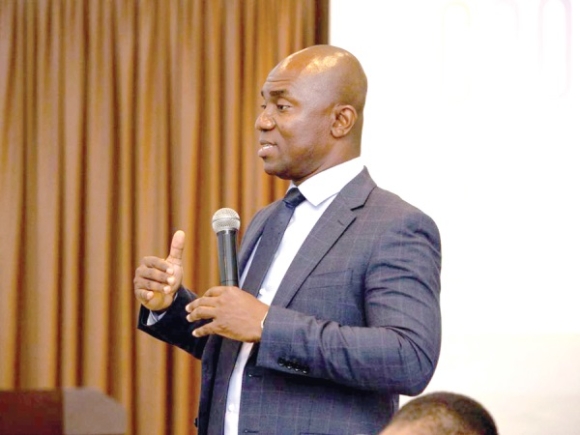
The Chief Executive Officer of the Chamber of Bulk Oil Distributors (CBOD), Dr Patrick Kwaku Ofori, has questioned the government’s GH¢2 per litre fuel subsidy, arguing that the flat-rate relief gives greater financial benefit to owners of large-capacity vehicles than to trotro operators.
He said the money spent on the subsidy could instead have been used to provide more than 200 buses to serve major commuter routes into Accra.
Speaking in an interview on Citi FM’s Eyewitness News on Thursday, September 17, 2026, Dr Ofori said motorists who bought larger quantities of fuel received more from the subsidy.
He cited the example of a V8 vehicle filling a 90-litre tank and a trotro buying about 25 litres for a journey between Madina and Circle.
“You are giving it more to those who can afford, and those who have conditions or services that these are going to be paid by their institutions or establishments,” he said.
He described the policy as “not a careful, thought-through process”.
Dr Ofori said investing the money in public transport would have provided a wider benefit to commuters.
“So you check the amount that we could have made if that has even been diverted into an investment into public transport,” he said.
“You would have had more than 200 buses on the street that will be taking people from Kasoa to Circle or Madina, Adenta or Tema Shinning to Accra.”
Dr Ofori attributed the latest increases in fuel prices to a combination of international developments, including tensions between the United States and Iran, attacks by Houthi rebels on pipelines supplying Europe and drone strikes on Russian refineries.
He said the attacks had affected diesel exports from Russia, while Saudi Arabia had cancelled refined product orders to Europe.
He also cited a decline in global petroleum reserves, saying stock levels in major regions had fallen below what he described as the normal 75 per cent storage threshold.
Dr Ofori said international prices had risen by more than 14 per cent for petrol and 7.5 per cent for diesel, resulting in higher pump prices despite the relative stability of the cedi.
Those figures differed from projections published by the Chamber of Petroleum Consumers (COPEC) on September 13, 2026. COPEC projected a 4.24 per cent increase in petrol prices and a 10.23 per cent rise in diesel prices for the same pricing window.
On the prospect of further government intervention, Dr Ofori questioned the sustainability of additional subsidies.
He said previous subsidy measures had placed costs on the downstream petroleum sector and warned that any relief introduced now would eventually have to be paid for by citizens.
He cited the Tema Oil Refinery (TOR) recovery levy, which followed earlier subsidies in the downstream petroleum sector, as an example.
Dr Ofori called for a long-term national energy strategy extending beyond electoral cycles.
He said such a strategy should include greater investment in alternative transport and the exploration of blended fuels such as ethanol.
On suggestions that the return of TOR and the Sentuo Oil Refinery could lead to lower pump prices, Dr Ofori said such an outcome was unlikely in the near term.
He explained that both refineries bought crude oil at internationally benchmarked prices and could not obtain discounted rates from the Ghana National Petroleum Corporation (GNPC) for Ghana’s crude parcels because of international trading rules governing commodity transactions.
He added that where shipments were already in transit when prices changed, suppliers had to raise fresh letters of credit to cover the price differences before the products could be discharged.
Dr Ofori also addressed a proposal for the government to use windfall revenue from higher crude oil prices to cushion consumers.
The proposal was attributed during the programme to the Chief Executive Officer of the Chamber of Oil Marketing Companies.
Dr Ofori said he could not confirm whether such a windfall existed, explaining that GNPC’s crude liftings were scheduled at intervals throughout the year.
He said the corporation might not have lifted any crude during the current price surge and suggested that the GNPC Chief Executive Officer and the Finance Minister were better placed to clarify the matter.
On transport fares, Dr Ofori said the Ghana Private Road Transport Union (GPRTU) would be justified in seeking an increase following the rise in fuel costs.
He urged drivers to treat passengers fairly and cautioned against practices such as dropping passengers and reloading along the same route to collect fares twice.
Further increases
Asked whether fuel prices would continue to rise, Dr Ofori said Ghana could face difficulties meeting normal demand if global supply constraints persisted into the northern hemisphere winter.
He cited a decline of between 500 million and one billion barrels in global petroleum product inventories over the preceding two months.
The next pricing window opens on Thursday, October 1, 2026.
