
The Ministry of Health has announced plans to introduce new financing measures and tighten payment controls in public hospitals, following an investigation which found that some patients were compelled to purchase surgical items themselves due to supply shortages.
The move comes after the Ministry received an investigative report into allegations of “medical kalabule” at the Greater Accra Regional Hospital and the Korle Bu Teaching Hospital.
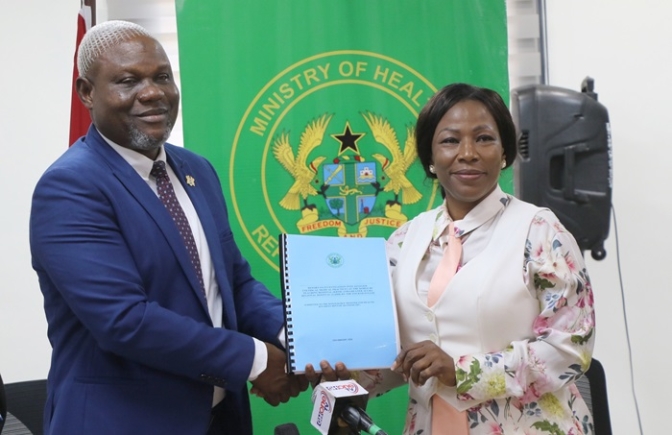
Presenting the government’s initial response, the Deputy Minister for Health, Prof. Grace Ayensu-Danquah, who received the report on behalf of the Minister, Mr Kwabena Mintah Akandoh, said the Ministry would pursue reforms to enhance transparency, accountability and access to essential medical supplies.
Supply gaps exposed
The committee identified systemic gaps, including financial constraints that have limited hospitals’ ability to stock specialised neurosurgical implants.
As a result, some patients were required to source these items from private suppliers prior to undergoing surgery.
To address the challenge, the committee recommended the establishment of a ring-fenced implant revolving fund to ensure a consistent supply of surgical materials, alongside stricter controls over payment processes within health facilities.
Breaches of protocol
The report also confirmed a breach of professional conduct involving a medical officer who accepted money directly from a patient for a surgical item required for an amputation, contrary to Ghana Health Service regulations.
In a separate instance, the committee cited an improper payment made in US dollars to a supplier, in violation of Bank of Ghana rules.
However, after reviewing the evidence, the committee noted that claims of deliberate collusion between doctors and suppliers — often described as “medical kalabule” — were not proven.
Wider systemic concerns
The findings highlight broader weaknesses within the health system, particularly in relation to access to procedures dependent on specialised implants.
To strengthen oversight, the committee proposed additional measures, including improved complaint handling mechanisms in hospitals, mandatory orientation on legal and ethical standards for health workers, and enhanced documentation and tracking of neurosurgical procedures and implant usage.
It also recommended the development of a clear policy framework to regulate intramural practice in public health facilities, an area frequently associated with concerns about informal payments.
Government response
On March 16, 2026, Prof. Ayensu-Danquah commended the committee for its work and assured that the Ministry would study the recommendations and take the necessary action.
The report underscores the burden placed on patients and their families when hospitals are unable to provide essential medical items, often forcing them to mobilise funds at short notice before treatment.
The Ministry further indicated that it would strengthen procurement systems and enforce strict compliance with payment protocols, while ensuring safe and ethical care for patients without resort to direct or informal payments.
