
Stakeholders back calls for regulation of political party financing, monetisation
Stakeholders in Ghana’s governance and political space have backed calls for stricter regulation of political party financing and monetisation of electoral politics.
They warned that the continuously rising cost of elections threatened Ghana’s democratic gains and stressed the urgent need to address the phenomenon.
Forum
The endorsement came at a multi-stakeholder forum organised by the Ghana Centre for Democratic Development (CDD-Ghana) in collaboration with the National Commission for Civic Education (NCCE), with support from the Foreign, Commonwealth and Development Office (FCDO), to deliberate on a proposed model political parties finance law.
The proposed model is intended to contribute to efforts aimed at reducing or eliminating the influence of money in Ghana’s political and electoral landscape.
The stakeholders at the forum, held in Bolgatanga, comprised representatives from the Electoral Commission, political parties, civil society organisations, the media, persons with disabilities, women and youth groups, among others.
Monetary influence
The participants agreed that the growing influence of money in politics was distorting electoral competition, excluding capable citizens from contesting public office, and creating fertile ground for corruption.
They also expressed support for proposals to cap campaign expenditure, define a clear campaign period, and enhance disclosure requirements for both political parties and candidates.
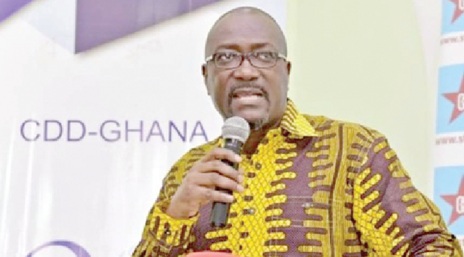
An Assistant Monitoring and Evaluation Specialist at CDD-Ghana, Jacob Tetteh Ahuno, said although Ghana had enjoyed three decades of competitive elections and peaceful transfers of power, monetisation was fast becoming a major threat to democratic governance.
“Our research reveals a staggering trend in the cost of contesting elections.
The cost of parliamentary contests has increased significantly over the years, and the cost of running for the presidency is now estimated at about US$100 million,” he said.
He described the trend as a “crisis of democratic capture,” explaining that when public office went to the highest bidder, women, youth and persons with disabilities were sidelined.
“When campaign costs keep rising, vulnerable groups are eliminated. More dangerously, we see the influence of political financiers whose funding sources are often opaque,” he stated.
Existing laws
Mr Ahuno noted that existing laws, including provisions under Article 55 of the 1992 Constitution and the Political Parties Act, primarily regulate political parties but did not adequately cover individual candidates.
“As it stands, candidates who receive donations are not required to account for them. The law does not clearly define a campaign period or set spending limits.
That is a major regulatory gap,” he said.
For his part, the Deputy Upper East Regional Director of the NCCE, Augustine Akugri, said the monetisation of politics had become deeply entrenched and posed an existential threat to the country.
“We are witnessing both the supply of money to voters and the demand for money from voters in elections and party primaries.
This undermines merit and distorts democracy,” he said.
Independent body
The Executive Director of the Africa Centre for International Law and Accountability (ACILA), William Nyarko, advocated the establishment of an independent body to regulate political parties and campaign financing.
He noted that a significant proportion of campaign contributions was given directly to candidates, yet current laws did not compel them to publicly disclose such funding.
Mr Nyarko also supported the introduction of spending limits, contribution caps, defined campaign periods, and stricter enforcement mechanisms, including sanctions for non-compliance. — GNA
