
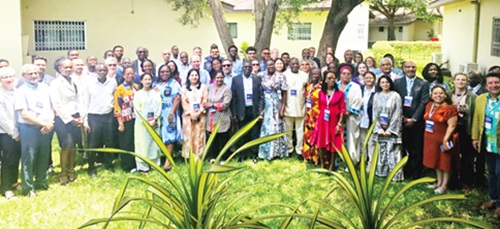
Health officials call for sustainable NCD solutions
A three-day global health symposium has ended in Accra, bringing together policymakers, funders and researchers from more than a dozen countries to accelerate sustainable responses to the rising burden of Non-Communicable Diseases (NCDs) across low-and middle-income countries.
The meeting was convened by the United Kingdom’s National Institute for Health and Care Research (NIHR) and hosted by the STOP-NCD Project – a West African centre for NCD control co-led by the Ghana College of Physicians and Surgeons (GCPS) and the London School of Hygiene and Tropical Medicine (LSHTM).
Held on the theme “Ensuring Sustainability from Global Health Research Centres,” the symposium marked a critical transition for five NIHR-supported centres, moving from co-designing interventions to full-scale implementation and evaluation across Africa, Asia, Latin America and the UK.
Government endorses research-driven health policy
Delivering remarks on behalf of the Health Minister, Kwabena Mintah Akandoh, the Director of External Health Cooperation at the Ministry of Health, Dr Hafez Adam Taher, underscored the importance of research in shaping effective health systems.
“Research allows us to identify interventions that are not only clinically effective but also sustainable, affordable and dependable to local contexts,” Dr Taher said. “Evidence generated within our settings is essential for informed decision-making and impactful policy design.”
He noted the alignment between the STOP-NCD initiative and government priorities, particularly the Free Primary Healthcare policy, which seeks to strengthen access and integrate NCD prevention and care into primary health systems.
Delivering a solidarity message on behalf of the Ghana Health Service (GHS), the Director-General, Professor Samuel Kaba Akoriyea, warned of the growing threat posed by NCDs.
Presenting data from the Kintampo Research Centre, he revealed alarming trends: “45 per cent of people above 40 years were diagnosed with NCD.
60 per cent of them did not know their status and 45 per cent were not on medication.
This, in part, explains the numerous strokes and the burden on our health system.”
Challenge to researchers
In a keynote address, Professor Kara Hanson, the Director of the NIHR Global Health Research Programme and Dean at LSHTM, challenged researchers to prioritise real-world impact.
Acknowledging reductions in the UK’s development assistance budget, she emphasised the need to demonstrate value. “Our mission should be to demonstrate the value of investing in global health research,” she said.
She noted that the UK’s evolving health strategy — shifting from cure to prevention, analogue to digital systems, and hospital-based to community-based care – aligns closely with the work of NIHR centres.
“Start planning your pathways to impact,” she urged. “These things don’t happen without effort. I have very high hopes for us.”
The symposium also featured updates from the Co-Director of STOP-NCD, Professor Irene Agyepong, who highlighted progress across the West African consortium.
Across the region, Burkina Faso is strengthening patient registries, while Niger is leveraging telemedicine to address workforce shortages.
