
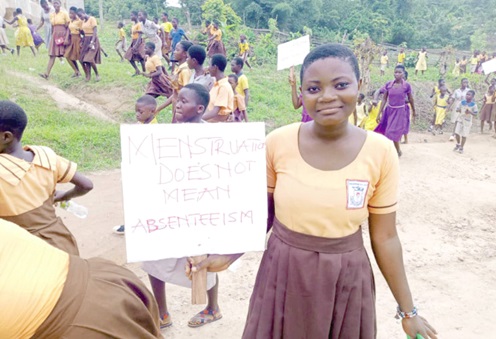
Menstrual Hygiene Day: Period should not cost a future
Every month, millions of women and girls across Ghana face a silent struggle that continues to undermine their dignity, education, health and economic participation: period poverty.
For many girls, menstruation is not merely a biological process. It is a monthly source of anxiety, stigma, and financial stress.
Some miss school because they cannot afford sanitary pads.
Others resort to unsafe alternatives such as old cloth, tissues, or rags, exposing themselves to infections and emotional distress.
In deprived communities, menstruation continues to widen inequalities and limit opportunities for girls and women.
As the world commemorates Menstrual Hygiene Day (May 28), there is renewed urgency to confront the realities faced by young women and girls who lack access to sanitary products, accurate menstrual health information, safe sanitation facilities, and supportive environments.
Understanding period poverty
Period poverty goes beyond the inability to afford sanitary pads. It includes: Limited access to menstrual products, inadequate water, sanitation, and hygiene (WASH) facilities, lack of menstrual health education, harmful myths and cultural stigma surrounding menstruation and policies and systems that fail to prioritise menstrual health for low-income households already struggling with the rising cost of living, purchasing pads every month becomes a difficult choice between menstrual hygiene and other basic necessities.
This challenge has contributed significantly to period poverty across the country, especially in rural and underserved communities.
Beyond the immediate health implications, period poverty affects school attendance, confidence, participation, and productivity among girls and women.
For many girls, managing menstruation becomes a monthly struggle marked by shame, discomfort, and exclusion.
In rural and low-income communities, especially, some girls resort to using unsafe materials such as old cloth, tissues, newspapers, or mattresses due to financial constraints.
Others stay home from school during their periods because they fear embarrassment, leakage or ridicule.
To its credit, in 2024, the government of Ghana declared the removal of taxes from raw materials used in the production of sanitary pads through CSO advocacy.
However, this is not reflecting in the current prices of sanitary pads.
Again in 2025, the Government of Ghana took a bold and commendable step by allocating approximately GH₵292.4 million in the 2025 budget for the distribution of free sanitary pads to female students in selected primary and secondary schools.
This initiative deserves recognition because it acknowledges menstruation as a national development issue rather than a private inconvenience.
For thousands of girls, especially those in deprived areas, this intervention could reduce absenteeism and restore dignity in the classroom.
It sends an important message that no girl should miss school because of her period.
However, while free pad distribution is a positive intervention, it should not become the only solution to period poverty in Ghana.
Policy action
The bigger and more sustainable conversation must focus on affordability.
Sanitary pads should not cost nearly GH₵20 or more in a country where many families struggle to meet daily basic needs.
Menstrual products are essential health commodities, not luxury items.
Yet taxes, import duties and production costs continue to make them inaccessible to many who need them most.
Globally, several countries have already recognised this reality and acted decisively.
Countries such as Kenya removed taxes on menstrual products years ago to improve affordability.
Scotland became the first country in the world to make period products freely accessible nationwide through public facilities.
Rwanda has also taken steps to remove VAT on sanitary pads, while countries including India and South Africa have reduced or eliminated taxes on menstrual products in efforts to tackle period poverty.
Ghana can learn from these examples.
If policy reforms and local manufacturing incentives are effectively implemented, sanitary pads could become affordable at much lower prices, potentially within the range of GH₵5 to GH₵8 for basic packs.
This would create long-term impact beyond government distribution programmes.
It would support working women, market women, out-of-school girls, persons with disabilities, and women in informal sectors who may not benefit directly from school-based interventions.
Equally important is investment in local production.
Ghana has innovative entrepreneurs already exploring low-cost and environmentally friendly sanitary pad alternatives using local materials such as banana fibre and plantain fibre.
Supporting such innovations through tax incentives, subsidies, and public-private partnerships could reduce dependency on imports while creating jobs and improving affordability.
Menstrual health must also be treated as a broader public health and gender equality issue.
Access to pads alone is not enough.
Schools and public spaces need safe water, sanitation, hygiene facilities, and menstrual health education. Stigma surrounding menstruation must be addressed through community engagement and comprehensive sexuality education.
Impact on education and well-being
Menstruation should never be a barrier to education, yet period poverty continues to disrupt the academic lives of many girls.
Missing several days of school each month can affect confidence, participation, and academic performance.
Beyond education, inadequate menstrual hygiene management can expose girls and women to infections, emotional distress, and social isolation.
Access to menstrual health and hygiene is not a privilege; it is a matter of health, dignity, education, and human rights.
Every girl and woman deserves the ability to manage menstruation safely, confidently, and without shame.
Role of advocacy and community engagement
Across Ghana, organisations and advocates continue to champion menstrual health awareness through education campaigns, pad distribution exercises, community dialogues, and youth engagement initiatives.
The Planned Parenthood Association of Ghana (PPAG), alongside partners and youth advocates, has consistently worked to advance sexual and reproductive health and rights, including menstrual health education for young people in and out of school through outreach programs and vulnerable populations.
Open conversations about menstruation are critical in dismantling stigma and creating supportive environments where girls can thrive.
Boys and men must also be included in these conversations to foster understanding and challenge harmful stereotypes.
Conclusion
This year’s Menstrual Hygiene Day, which is being commemorated on the theme: “Together for a #PeriodFriendlyWorld” serves as a reminder that no one should be held back because of their period.
It is a call to action for increased investment in menstrual health, improved access to affordable sanitary products, comprehensive menstrual education, and stronger policies that prioritise the needs of women and girls.
Ending period poverty requires more than symbolic gestures.
It demands sustainable solutions, inclusive policies, and continued advocacy to ensure that menstruation is managed with dignity for all.
As we commemorate Menstrual Hygiene Day, let us commit to breaking the silence, challenging stigma, and building a society where every girl and woman can menstruate safely, confidently, and with dignity.
Menstruation is Natural. Period Poverty Should NOT Exist.
This article is by PPAG
