
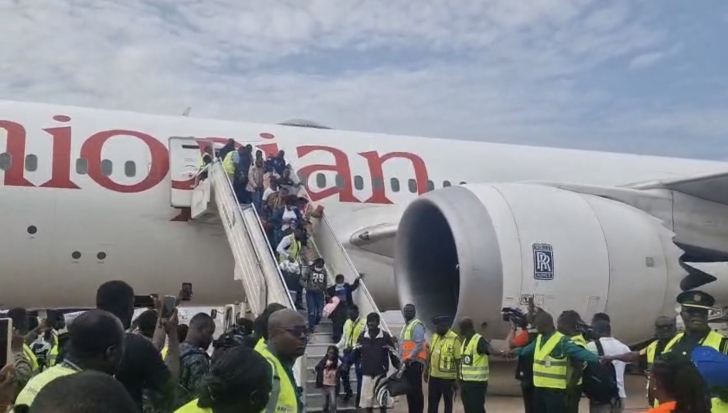
The arrival of 300 Ghanaians evacuated from South Africa at Accra’s Kotoka International Airport on Wednesday, May 27, 2026, was more than a logistical operation.
It was a statement of who we are as a nation.
To see families, officials and security agencies gather at Terminal Two to receive citizens returning after weeks of uncertainty and fear is to witness the state perform one of its most basic duties: protecting its people, wherever they may be.
To step onto home soil after such an ordeal is to understand, viscerally, the meaning of statehood and belonging.
The government’s response deserves acknowledgement. Led by the Chief of Staff, Julius Debrah, and the Minister of Foreign Affairs, Samuel Okudzeto Ablakwa, a high-level delegation welcomed the returnees.
The presence of senior officials signalled that this was not a routine consular matter.
It was a national priority.
The operation itself was a product of inter-agency coordination and international cooperation.
The Office of the Chief of Staff, NADMO, the Ministry of Gender, Children and Social Protection, the International Organisation for Migration, and the staff of the Foreign Affairs Ministry worked together to make it possible.
The government also negotiated directly with South African authorities for the release of the 26 detained Ghanaians.
That diplomacy should not go unnoticed. It is a reminder that foreign policy is not abstract; it is about the safety and dignity of individual citizens.
The minister’s words captured the stakes: “Today, the Mahama administration is demonstrating that wherever Ghanaians are, we will make sure you are protected, your dignity is respected, and we will go to the length of this world to bring you back home safely.”
That is the standard. Citizenship must mean something beyond the passport page.
It must mean that when Ghanaians are in distress abroad, the state will act decisively and humanely.
What matters now is that the state follows through on its promise of support so that resilience can become reality.
The transition from evacuation to reintegration is where many such operations falter.
Job placement, skills training, access to credit, and mental health support will determine whether these 300 citizens rebuild their lives or remain adrift.
One of the returnees, Victor Togbe Atsu, who proposed the vote of thanks, summed up the experience starkly: We have been rescued from the lion’s den.
It was hell in a cell.” His gratitude to the government and to God reflected the depth of what had been endured.
It also placed a responsibility on the nation to ensure that “never again” is not just a slogan.
This episode also raises broader questions about the protection of Ghanaians abroad.
Thousands live and work across Africa and beyond, contributing remittances, skills and goodwill.
The state must strengthen its consular capacity, update its diaspora data, and establish rapid-response protocols for crises.
Partnerships with airlines, international organisations and host governments should be pre-negotiated to help shorten response times during emergencies.
At the same time, Ghanaians abroad must be reminded of their obligation to respect the laws of host countries.
The inclusion of 26 detainees for visa violations in the evacuation does not excuse irregular migration.
Government’s duty to protect does not absolve individuals of responsibility. Safe, regular migration benefits everyone.
The xenophobic violence that prompted this evacuation is a stain on Africa’s integration project.
Africans cannot preach Pan-Africanism while attacking one other on the streets.
And so far, the government’s response—calm, diplomatic, and focused on protecting lives—sets a model for how African states should handle such crises.
We must continue to use regional platforms such as ECOWAS and the African Union to address the root causes of xenophobia: unemployment, misinformation and weak law enforcement.
For now, the immediate task is to receive these 300 citizens with dignity and help them start again.
The food, the allowances, the medical and psychosocial support are the right first steps.
But the true measure of success will be six months from now, when we ask whether these returnees have regained stability, purpose and hope.
Welcoming home our own is easy when the cameras are rolling.
Standing with them when the cameras leave is the real test of national responsibility.
Evacuation without reintegration risks trading one form of vulnerability for another.
Ghana has passed the first test.
Let us now pass the second.
