
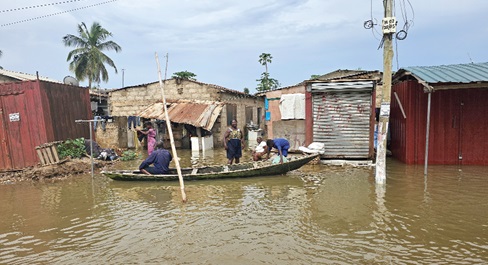
Buildings of various sizes, vehicles and other property of residents in parts of the Weija-Gbawe and Ga South municipalities in the Greater Accra Region have been submerged in floodwaters.
This follows what the Ghana Water Ltd (GWL) has described as “controlled spilling of water from the Weija Dam”, which supplies water to the Western part of Accra.
The spillages intensified from Wednesday because the Weija reservoir has collected water up to its limit of 48 feet, and has to open its sluices to spill excess water.
Usually, the company starts spilling when the water gets to 45 feet, but it had to wait a while for the rains to subside.
Management
“The Management of Ghana Water Limited wishes to inform the general public that the water level in the dam has currently risen above the maximum operating level of 48 feet.
Consequently, all spill gates of the dam are being opened to allow for the controlled spillage of excess water in order to safeguard the structural integrity and safety of the dam,” a release issued by the GWL said.
Areas
The areas affected included Weija, Oblogo, White Cross, Sampah Valley, Kwame Anum, Ashalaja, Obolo and Brigade.
The spillage displaced many occupants of the buildings and other structures, which have now been submerged.
Children in the affected areas could not go to school as educational institutions had to close down because of the situation.
Residents who were able to salvage a few belongings have also sent family members, including the elderly and children, to other relatives outside the affected areas, leaving a small party to watch over the remainder of their belongings.
Unaware
Many residents who said they did not know about the spillage had resorted to frantic measures to evacuate, leaving their belongings behind.
Motorbike services in the communities have become expensive as people rely on them to leave their homes.
The Daily Graphic team that visited the area also spotted canoes being used to carry some personal effects.
The last time this happened was four years ago, and no remedial changes, if any, are visible.
Dignitaries
The Ga Mantse, King Tackie Tawiah; the Greater Accra Regional Minister, Linda Obenewaa Ocloo; the Metropolitan Chief Executive of Accra, Michael Kpakpo Allotey; the Municipal Chief Executive of Weija-Gbawe, Felix Odartey Lamptey, among other dignitaries, visited Tetegu to commiserate with the residents.
The Ga Mantse, in a media briefing advised them to relocate within the next 48 hours to the centre created by NADMO and the Regional Coordinating Council for their safety.
"Leave this property behind and save your life," he said.
Others present were members of the 48 Engineers Regiment and the National Disaster Management Organisation (NADMO).
The team observed that part of the main road leading to the Tetegu community had been ravaged by the flood, leaving gullies and potholes.
Bridge
Residents had also parked their cars on both sides of the road all the way towards the main bridge linking the Tetegu and Kasoa-Mallam road.
Two residents, Paulina and Anita, told the Daily Graphic that they did not have anywhere to go, thus the decision to hang around for the water to recede.
"We don't even have a place to sleep and bath. I had to stay awake throughout the night till now because I don't have anywhere in mind," Paulina said.
Sentiments
Anita, who shared similar sentiments, said she had lost everything in her shop.
A nursing mother carrying her six-month-old child was seen in tears.
She would not talk to the team when she was approached to explain why she was so emotional.
Meanwhile, the St Peter Roman Catholic Church at Tetegu has provided temporary shelter for stranded residents.
Plush
At Sampah Valley, it was observed that plush buildings had been submerged, as some occupants could be seen carting some of their personal effects away.
Some residents, including Oppong, Cynthia, Evans and Nii Lante, supported other views that they were not aware of any announcement about the spillage.
They said the GWL should not have waited for the water level to rise before opening the gates.
Mr Oppong also said the goods he had imported to sell had been damaged.
MCE
At Sampah Valley, the Ga South Municipal Chief Executive, Moses Kabu Kubi Ocansey, and the Ga South National Disaster Management Organisation (NADMO), Isaac Nelson Akrobotu, toured the affected communities, including Ashalaja, Kwame Anum, Obolo, Brigade and Amanfro.
The MCE also led the demolition of a wall at the Sampah Valley, which was on a watercourse.
Mr Ocansey told the Daily Graphic that NADMO had been asked to evacuate residents who needed help, but he charged persons in low-lying areas to relocate to safer ground due to the rains.
He said the estuary had been dredged to ensure the free flow of water into the sea.
Mr Ocansey cautioned developers from building on watercourses since any such facilities would be pulled down.
"The dredging we did yesterday could have been done before the opening of the gates (of the dam). Unfortunately, it happened so suddenly," he said.
For his part, Mr Akrobotu said some of the affected persons were being accommodated in hotels.
He said a sick woman who was rescued from her home was receiving care at the hospital.
He explained that four out of five gates of the dam were opened last Wednesday and that "caused the flooding here".
The NADMO Director said the areas affected were Ramsar sites and buffer zones for the dam. He, therefore, cautioned people from building at the place.
The GWL had indicated that the current exercise had become necessary due to continuous inflows into the dam, coupled with forecasts of more heavy rainfall in upstream areas by the Ghana Meteorological Agency.
It stated that the anticipated torrential rainfall was expected to further increase inflows into the dam area, making it necessary for the spilling operation to continue until the water level receded to a safe operating level.
It explained that the process could continue for some months, depending on rainfall patterns and the volume of inflows into the dam.
GWL, therefore, urged all residents and communities situated along the course of the river downstream of the dam to cooperate fully with emergency officials and adhere to all safety directives to avoid possible loss of lives and property.
Collaboration
The company further stated that the National Disaster Management Organisation (NADMO) and various district assemblies had initiated plans to clear structures and other obstructions that impeded the free flow of water into the sea.
It said such measures were critical in minimising the risk of flooding in affected communities during the spilling period.
The GWL consequently appealed to the relevant authorities to expedite the exercise to ensure that drainage channels remained clear for the water to flow freely into the sea.
